Whom Should the People Hold Accountable? LG or CM? Dual Power Centre, Single Sufferer: The People

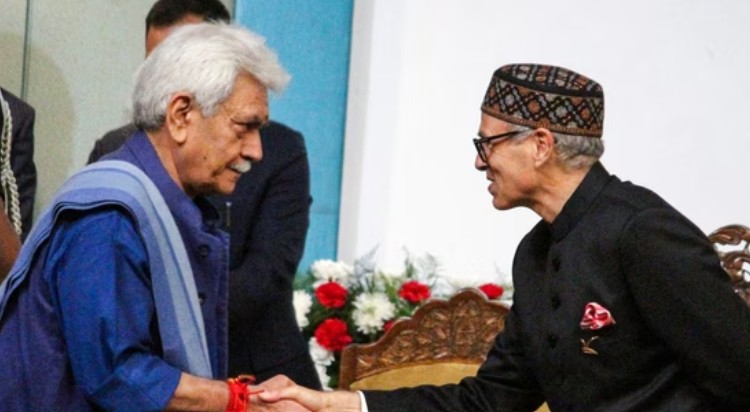
Jammu and Kashmir today finds itself trapped in an unusual governance model. It has an elected government headed by a Chief Minister, yet several key powers continue to rest with the Lieutenant Governor. Whenever a problem surfaces, the inevitable question follows: Who is actually responsible?
The answer, unfortunately, is rarely clear. And while constitutional debates continue, it is the ordinary citizen who pays the price.
Take the soaring prices of essential commodities. Eggs, vegetables and fruits have become significantly more expensive over the past few weeks. Consumers complain that market inspections are either absent or restricted to festivals such as Eid and Ramadan. Traders continue charging whatever they please, while authorities remain invisible. Is price regulation the responsibility of the elected government or the administration headed by the Lieutenant Governor? The public deserves an answer.
The same confusion surrounds the worsening drinking water crisis. Localities across Kashmir continue to report prolonged shortages. Residents make repeated appeals, tankers arrive late—or not at all—and departments blame technical issues. Citizens are left wondering whether they should approach the Chief Minister’s office or Lok Bhavan.
Power cuts present another painful reality. Despite official assurances and promises of better infrastructure, scheduled and unscheduled outages continue to inconvenience households, businesses and students alike. Every summer and every winter, the same explanations are repeated while little changes on the ground.
Perhaps the most visible symbol of administrative failure is the condition of roads. Across towns and villages, roads remain battered with potholes and broken surfaces. The macadamization process moves at a painfully slow pace. Contractors complain of pending payments stretching back years, while commuters continue to damage their vehicles and risk their lives on neglected roads.
Read: The Indomitable Fate
This is where the dual power structure exposes its greatest weakness. Success is readily claimed by one side or the other, but when governance fails, responsibility becomes blurred. One office points towards constitutional limitations, the other towards administrative jurisdiction. Meanwhile, the public is left running from one authority to another without finding solutions.
The issue is not about personalities or political parties. It is about accountability.
People do not vote for confusion. They expect governance. They do not distinguish between departments controlled by the Lieutenant Governor and those managed by the elected government when their taps run dry, electricity disappears, markets become unaffordable or roads remain damaged. To them, government is government.
The present arrangement has created a vacuum where accountability often becomes the first casualty. If responsibilities are divided, they must also be clearly communicated. If powers are shared, then ownership of public problems must also be shared.
Ultimately, governance is judged not by constitutional provisions but by outcomes. Clean drinking water, affordable essentials, uninterrupted electricity and motorable roads are not political slogans; they are basic expectations of every citizen.
The people of Jammu and Kashmir deserve more than explanations. They deserve answers. More importantly, they deserve a government, whether through Lok Bhavan, the Civil Secretariat, or both—that accepts responsibility instead of passing it.
Because in a system with two centres of power, there cannot be two centres of blame and no centre of accountability.
© Kashmir News Trust (KNT). Unauthorized use without attribution is prohibited.