The Boycott That Weakened Jammu and Kashmir’s Voice

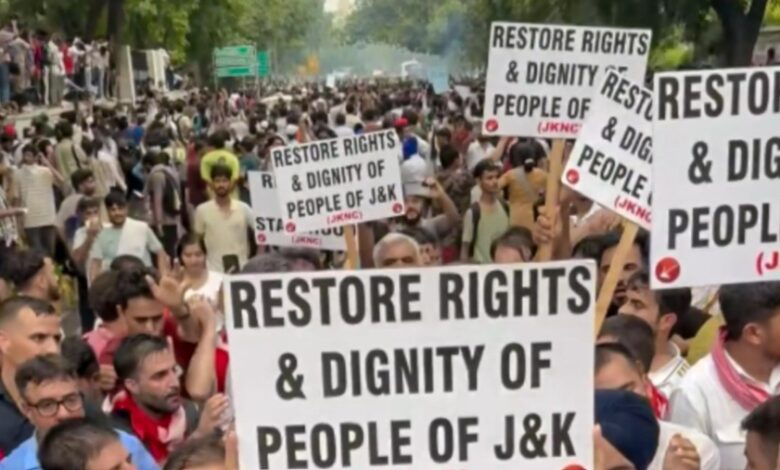
When the National Conference took to the streets of Delhi demanding the restoration of Jammu and Kashmir’s statehood, the protest should never have been viewed through the narrow prism of party politics. Statehood is not the property of any political party. It is the constitutional right of the people of Jammu and Kashmir and a promise repeatedly made by the Union Government itself.
Yet, several Kashmir-based political parties chose to stay away.
Their explanations ranged from “we were not consulted” to “Article 370 should have been part of the protest.” These arguments may satisfy party workers, but they do little to convince a public that has endured nearly seven years under a Union Territory arrangement with a weakened democratic mandate.
One question deserves an honest answer: if a party truly believes that Jammu and Kashmir should regain its statehood, why refuse to stand shoulder to shoulder with others demanding exactly that?
Political differences are natural. Electoral rivalry is inevitable. But constitutional issues affecting an entire region require political maturity. Across India, opposition parties routinely join hands on issues despite sharp ideological differences. Why should Jammu and Kashmir be any different?
The absence of a united political front has only strengthened those who have opposed the restoration of statehood from the very beginning. Division among regional parties serves no one except those who prefer the status quo.
Read: The Indomitable Fate
Some parties argued that the protest should also have focused on Article 370. There is nothing wrong with advocating for Article 370. But insisting that every protest must carry every political demand is strategically unsound. Politics is often about securing achievable milestones. Statehood and Article 370 are distinct constitutional questions. Supporting one does not amount to abandoning the other.
By refusing to participate in a movement centred on statehood, these parties allowed procedural objections and political ego to overshadow a cause that affects every citizen irrespective of political affiliation.
Equally disappointing was the conduct of certain fringe Pandit groups that confronted protesting leaders during the demonstration in Delhi. Instead of respecting a peaceful democratic protest, they attempted to disrupt it through slogans and confrontation. Whether knowingly or otherwise, such actions only diverted attention from the core demand and weakened the broader campaign for restoring democratic rights.
The greatest beneficiaries of this political fragmentation are those who have consistently resisted restoring full statehood. Every boycott, every public disagreement and every parallel narrative dilutes the collective voice of Jammu and Kashmir. Constitutional rights are not reclaimed through competing press conferences but through unity of purpose.
The present governance arrangement has created a dual power structure that continues to constrain the elected government. An administration answerable to the people cannot function effectively when crucial powers remain elsewhere. Regardless of political preferences, this reality affects governance, accountability and public confidence.
History rarely remembers who was invited to a protest. It remembers who stood up when the moment demanded courage.
Statehood is too important to become another casualty of political one-upmanship. The people of Jammu and Kashmir deserve leaders who can rise above party lines when the constitutional interests of the region are at stake. If political parties cannot unite even on a demand they all publicly claim to support, the public is justified in asking whether electoral calculations have taken precedence over the larger cause.
The struggle for statehood belongs to the people, not to any single party. Those who chose to stay away may have preserved their political positioning, but they missed an opportunity to strengthen a collective demand that transcends partisan boundaries.
© Kashmir News Trust (KNT). Unauthorized use without attribution is prohibited.