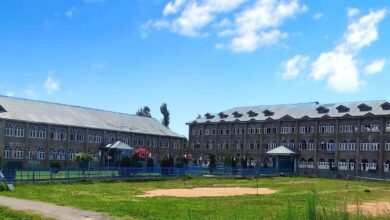
J&K Lost 5,089 Government Schools in a Decade; NITI Aayog Flags 146 Zero-Enrolment Schools


Srinagar, Aug 15, KNT: Jammu and Kashmir has seen a reduction of 5,089 government schools over the past decade, while the latest NITI Aayog assessment has highlighted another concern within the remaining network: 146 government schools had no students enrolled at all in 2024-25 and another 1,371 were functioning with only a single teacher.
Government data shows that the number of government schools in J&K fell from 23,874 in 2014-15 to 18,785 in 2023-24, a reduction of 5,089 institutions, or more than 21 per cent of the network that existed at the beginning of the period.
The sharpest reduction came after 2018-19. The number of government schools stood at 24,080 in 2018-19 before falling to 23,165 in 2019-20 and remaining around 23,000 through 2021-22. It then dropped sharply to 18,785 in 2022-23 and remained at that level in 2023-24.
However, the figure of 5,089 should not automatically be interpreted as 5,089 schools being physically shut down. Government data has described the reduction in terms of closure and merger, while the NITI Aayog report places the broader national trend in the context of school rationalization, consolidation and merging of under-enrolled institutions.
NITI Aayog’s latest report, as per the news agency Kashmir News Trust based on UDISE+ 2024-25 data, says the decline in the number of schools nationally reflects consolidation of the school network, including rationalization and merging of under-enrolled institutions. The report argues that the objective is to optimize resources rather than simply increase the absolute number of schools.
But the J&K figures raise a question that goes beyond the arithmetic of school rationalization.
If thousands of government schools have been removed from the network while hundreds of the schools that remain have virtually no students or only one teacher, the issue is no longer simply how many school buildings exist. It is whether the restructuring has produced a more accessible and better staffed education system for children, particularly in remote and difficult terrain.
The NITI Aayog report records 146 government schools in J&K with zero enrolment in 2024-25. Despite having no students, these schools continued to exist in administrative records, with 61 teachers posted across them. The report notes that zero-enrolment schools can continue to receive financial and human resources because administrative records are not always updated to reflect the ground reality.
The situation is accompanied by a large number of single-teacher schools. According to the same NITI Aayog table, 1,371 J&K schools had only one teacher, serving a combined enrolment of 32,303 students. Such schools can require a single teacher to handle multiple grades and administrative responsibilities, creating obvious limitations for classroom instruction.
The problem becomes more significant when viewed against J&K’s learning outcomes.
In PARAKH 2024, J&K recorded 46 per cent in Language, 39 per cent in Mathematics and 41 per cent in The World Around Us, compared with all-India averages of 57 per cent, 46 per cent and 49 per cent respectively. J&K therefore remained below the national average in all three assessed areas.
This creates a more complicated picture than a simple claim that school closures have either improved or damaged education.
On one hand, maintaining extremely small or empty schools can consume teachers and public resources without serving students effectively. On the other, indiscriminate consolidation in a geographically difficult region can increase the distance children have to travel and make access to education harder, particularly in remote and sparsely populated habitations.
NITI Aayog itself acknowledges this tension in its assessment of difficult geographies, noting that rural and remote regions, particularly those with difficult terrain, can face long travel distances, rough roads and irregular transport, making regular attendance challenging. It says dispersed settlements and low-density habitations complicate efforts to provide schools within easy reach of every community.
The report therefore raises a question for Jammu and Kashmir that cannot be answered merely by celebrating rationalization: where have the children from the schools that disappeared from the network gone, how far do they now travel for schooling, and has the merger of institutions actually improved teaching and learning?
There is another issue requiring scrutiny. The latest data shows that the problem is not simply an excess of schools. J&K simultaneously has zero-enrolment schools and a substantial number of single-teacher schools. That suggests that school rationalization, teacher deployment and student distribution may not yet be aligned effectively.
The figures also raise questions about the basis on which schools were selected for merger or closure, whether minimum-distance norms were maintained in remote areas, and whether the Government assessed the impact on enrolment, attendance and dropout rates before consolidating institutions.
NITI Aayog’s findings therefore present a mixed picture for J&K: the government school network has contracted sharply, yet the remaining system continues to contain schools with no students and a large number operating with only one teacher, while learning outcomes remain below the national average. [KNT]
© Kashmir News Trust (KNT). Unauthorized use without attribution is prohibited.