Omar Abdullah: Legacy, Leadership and the Test of Governance
For now, his leadership is defined not only by history but by the urgency of execution in a politically and economically sensitive region.

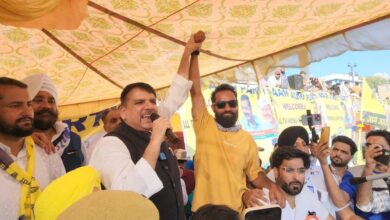
![Omar Alleges Bid to Split NC, Claims MLA Offered ₹20–30 Crore to Defect Srinagar, July 11, KNT: Chief Minister Omar Abdullah on Saturday accused the Bharatiya Janata Party (BJP) of attempting to destabilize the National Conference-led government, alleging that one of his party's legislators from the Jammu region was offered between ₹20 crore and ₹30 crore, a ministerial berth and political assurances to defect in what he described as a failed bid to engineer a split in the ruling party. Addressing a gathering after paying tributes to Begum Akbar Jehan at Naseem Bagh, Omar claimed the offer was allegedly conveyed through a Supreme Court lawyer associated with the BJP, who, according to him, assured the legislator that statehood would be restored if he switched allegiance. Declaring that the National Conference would not succumb to pressure or inducements, the Chief Minister warned the BJP against attempting to enter government through what he termed "the back door", asserting that the party's patience should never be misconstrued as weakness. Turning his attack towards the Centre, Omar questioned why an elected government was being forced to stage a protest in New Delhi nearly two years after assuming office merely to seek restoration of Jammu and Kashmir's statehood. He said he had deliberately adopted the path of dialogue instead of confrontation, despite being aware that the approach would invite political criticism within Jammu and Kashmir. "I staked my political credibility on the assurance that the promises made to the people of Jammu and Kashmir would be honoured. I believed dialogue would succeed where confrontation would not. Unfortunately, our patience has been rewarded with continued delay," he said. The Chief Minister as per the news agency Kashmir News Trust reminded the Centre that it had assured the Supreme Court that statehood would be restored after the completion of delimitation and Assembly elections. Both processes, he said, had concluded, yet the commitment remained unfulfilled. Questioning the delimitation exercise, Omar alleged that Jammu and Kashmir had witnessed a politically motivated exercise designed to benefit the BJP. Despite what he termed an attempt to tilt the electoral balance, he said the electorate had defeated those designs by handing the National Conference a decisive mandate. "Our victory has become our punishment," he remarked, questioning why elections were held if the intention was to continue governing Jammu and Kashmir through Raj Bhavan instead of respecting the mandate of an elected government. Escalating his criticism, Omar alleged that the Centre had responded positively to political demands from Ladakh while ignoring similar concerns raised by the elected government in Jammu and Kashmir. He claimed that while Ladakh was being engaged on constitutional safeguards, Jammu and Kashmir continued to be denied even routine administrative powers, including the appointment of officers. The Chief Minister said he had repeatedly raised the issue of statehood with Prime Minister Narendra Modi and Union Home Minister Amit Shah but was consistently told that restoration would take place at an "appropriate time." "What is this appropriate time? Tell us what more remains to be done. If the appropriate time means the formation of a BJP government in Jammu and Kashmir, then say so openly before Parliament and the people," he said. Rejecting criticism over the National Conference's decision to invite political parties and civil society members for the proposed July 20 protest at Jantar Mantar, Omar asserted that the struggle for statehood transcended party politics. "Statehood does not belong to Omar Abdullah or Dr. Farooq Abdullah. It belongs to every citizen of Jammu and Kashmir. That is why we have invited everyone to join this movement," he said. [KNT]](https://newsagencyknt.com/wp-content/uploads/2026/02/Chief-Minister-Omar-780x470.png)
As Chief Minister Omar Abdullah presented the Budget this week, the spotlight returned to a leader whose political journey has been shaped by legacy, turbulence and evolving regional realities.
Born into Jammu and Kashmir’s most prominent political family, Omar Abdullah entered Parliament in 1998 as one of the youngest MPs from the Valley. He later served as Minister of State for External Affairs in the Union government before assuming leadership of the National Conference. His first tenure as Chief Minister from 2009 to 2015 unfolded during a politically sensitive period marked by civil unrest, security concerns and mounting public expectations.
While supporters credit him for attempting administrative reforms and pushing development initiatives, critics argue that his earlier term struggled to bridge the trust deficit between the government and sections of the population. Periodic unrest and governance challenges often overshadowed policy measures, raising questions about institutional responsiveness and crisis management.
Following the constitutional changes of 2019 and the reorganization of the erstwhile state into a Union Territory, Omar Abdullah re-emerged as a central political voice advocating restoration of democratic structures and statehood. His return to the Chief Minister’s office has placed him in a more complex administrative framework, where financial autonomy, bureaucratic coordination and Centre-UT relations require careful navigation.
The Budget presented this week outlines priorities including infrastructure expansion, employment generation and strengthening of social sectors. However, observers note that translating allocations into visible outcomes remains the key challenge. Concerns persist over unemployment levels, slow execution of large infrastructure projects, fiscal constraints and the need for greater transparency in governance.
Additionally, critics within the opposition have questioned the pace of delivery on campaign promises and called for stronger accountability mechanisms. Public sentiment, especially among youth, is closely tied to tangible improvements in jobs, healthcare and investment.
Omar Abdullah today stands at a crossroads between inherited political legacy and performance-driven governance. The coming years will test whether his administration can convert policy intent into measurable results, restore institutional confidence and balance regional aspirations with administrative realities.
For now, his leadership is defined not only by history but by the urgency of execution in a politically and economically sensitive region. [KNT]
© Kashmir News Trust (KNT). Unauthorized use without attribution is prohibited.