
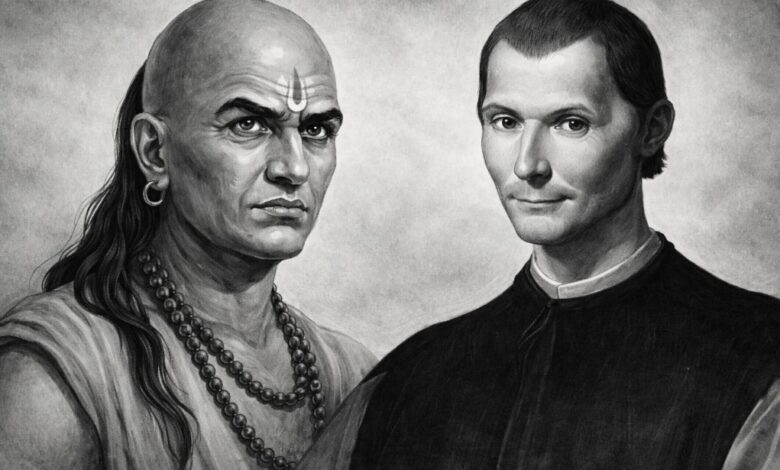
Below is a structured comparison of the political philosophies of Chanakya and Niccolò Machiavelli, discussing their similarities, differences, ethical dimensions, and relevance in the modern world.
Chanakya vs Machiavelli: Similarities, Differences, Ethics and Relevance in the Modern World
1. Historical Background
Chanakya (Kautilya) lived in the 4th century BCE in ancient India and was the chief advisor to Chandragupta Maurya. His ideas are recorded in the political treatise Arthashastra, which deals with governance, economics, diplomacy, espionage, and military strategy.
Machiavelli lived during the political instability of Renaissance Italy. His famous work The Prince explains how rulers can gain and maintain power in turbulent political environments.
Although separated by nearly 1,800 years, both thinkers developed ideas about realistic governance and political strategy.
Similarities Between Chanakya and Machiavelli
1. Political Realism
Both philosophers rejected idealistic views of politics and emphasized practical realism.
They believed rulers must understand human nature, power struggles, and political manipulation.
Both acknowledged that deception, espionage, and strategic cruelty might sometimes be necessary.
2. Importance of Strong Leadership
Both thinkers believed that weak rulers invite chaos.
A ruler must be:
-
decisive
-
strategic
-
capable of maintaining authority
Both warned that political instability arises when leadership is indecisive.
3. Use of Intelligence and Espionage
Chanakya proposed a highly organized spy network to monitor enemies and internal threats.
Machiavelli also supported the use of information gathering and political manipulation to maintain control.
Both recognized information as power.
4. State Security Above All
Both believed the survival of the state is the highest priority.
They argued that leaders must sometimes make hard or morally uncomfortable decisions to protect the state.
Differences Between Chanakya and Machiavelli
1. Moral Foundation of Governance
This is the most important difference.
Chanakya
Chanakya’s political philosophy is rooted in dharma (moral duty).
He believed:
“The happiness of the king lies in the happiness of his subjects.”
Power was a tool to ensure public welfare.
Machiavelli
Machiavelli separated politics from morality.
He argued that rulers must be prepared to act immorally when necessary.
His famous idea:
A prince must learn how not to be good.
2. Purpose of Political Power
Chanakya believed power should be used for:
-
social stability
-
economic prosperity
-
protection of citizens
Machiavelli focused more on:
-
maintaining authority
-
preventing rivals from seizing power
3. Administrative Vision
Chanakya wrote about:
-
taxation
-
economic policy
-
agriculture
-
public welfare
-
law and justice
His work is a complete manual of governance.
Machiavelli’s work mainly focuses on political leadership and survival of rulers, not detailed administrative systems.
Ethical Evaluation of Their Philosophies
Chanakya’s Ethics
Chanakya’s philosophy combines:
-
realism
-
moral duty
-
welfare of citizens
He accepted harsh tactics only when necessary for public interest.
Many scholars argue that Chanakya created ethical realism in politics.
Machiavelli’s Ethics
Machiavelli’s philosophy is often associated with the idea:
“The end justifies the means.”
Although Machiavelli never wrote that exact phrase, his ideas imply that moral rules may be ignored to preserve power.
Because of this, the term “Machiavellian” is often used to describe manipulative or ruthless politics.
Are These Philosophies Visible in Modern Politics?
In reality, many modern states practice a mixture of both approaches.
Countries Reflecting Chanakya-Style Governance
Elements of Chanakya’s philosophy can be seen in states that emphasize:
-
strong administration
-
welfare policies
-
strategic diplomacy
Examples often cited by scholars include:
-
India
-
Singapore
-
Japan
These states combine strategic realism with strong governance systems.
Countries Often Associated With Machiavellian Realism
Machiavellian tactics can appear in states where power politics dominates diplomacy.
Examples often discussed include:
-
Russia
-
China
-
United States
In global politics, realpolitik and strategic manipulation sometimes resemble Machiavelli’s ideas.
However, no country follows Machiavelli purely; they combine power politics with democratic values or national interests.
Are These Philosophies Applicable Today?
Both philosophies remain highly relevant.
Chanakya in Modern Governance
Chanakya’s ideas influence modern concepts such as:
-
strategic diplomacy
-
economic planning
-
intelligence agencies
-
national security
His emphasis on good governance and welfare aligns with modern democratic principles.
Machiavelli in International Relations
Machiavelli’s realism is often seen in:
-
geopolitical competition
-
covert operations
-
strategic alliances
-
military power politics
International relations theory often reflects Machiavellian realism.
Are These Philosophies Morally Upright?
This question remains deeply debated.
Strength of Chanakya’s Philosophy
Chanakya attempts to balance:
-
realism
-
morality
-
welfare
Therefore many scholars consider it ethically stronger.
Criticism of Machiavelli
Machiavelli’s philosophy can justify:
-
manipulation
-
authoritarianism
-
political cruelty
Critics argue that such ideas may undermine democratic values.
However, some scholars defend Machiavelli by saying he simply described politics as it actually works, rather than how it should work.
Conclusion
Chanakya and Machiavelli represent two forms of political realism.
Chanakya integrates strategy with moral responsibility and public welfare, while Machiavelli focuses on power preservation and political survival.
In today’s world, most governments operate somewhere between these two philosophies, combining pragmatic power politics with ethical governance.
Understanding these thinkers remains essential for analyzing modern leadership, diplomacy, and statecraft.
© Kashmir News Trust (KNT). Unauthorized use without attribution is prohibited.