
Once a Brahmin went to Kashi and attained mastery in astrology. He had studied several voluminous books on astrology. He could predict the present, the past and the future events of a person by reading his palm and the forehead, as if he knew the happenings of all the three stages of time. He was proud of being an astrologer par excellence.
After returning from Kashi the Brahmin had decided to stay in his village for a few days. He had thought that from the village he would go straight to the king’s palace where he could exhibit his rare talents as an astrologer and win the lofty honour of the Royal Astrologer. For some days he stayed in the village and impressed the villagers with his skill in astrology. Then he moved on to the king’s court.
On his way night fell and the Brahmin had to stay for the night in a certain village. He decided to stay for the night at a carpenter’s house. The carpenter whole-heartedly welcomed the Brahmin. He offered food and shelter to the Brahmin. The Brahmin wanted to pay him back then and there. When the night descended the Brahmin decided to entertain the carpenter with religious discourses. When the Brahmin commenced his discourse, the carpenter started his own work. Seeing this the Brahmin said, “Good fellow, you are busy with your work. You should pay your attention to my discourse only and this is not the proper time to attend to your work.”
The carpenter said, “You go ahead with your narration. My ears are busy listening to you.”
“But I do not relish this. You should devote some time for this noble purpose also,” the Brahmin said to the carpenter.
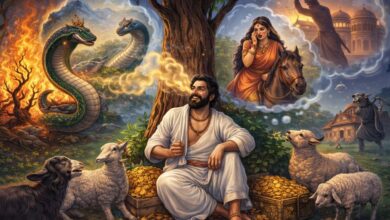
“But I have a very urgent work to attend. On the next morning, the Patwari of this village has to move out on tour. Near the well, on the outskirts of the village, he will fall from his horse and injure his foot. His people have to bring him to me to get a foot-rest made from me. So I am making a foot-rest in advance for his use,” the carpenter replied.
The Brahmin gave a brazen look at the carpenter and asked, “How can it be? How do you know what is going to happen tomorrow? You are an ordinary carpenter.”
“I do not know all that, but the elders say that work is worship, devotion to duty carried miracles with it. I always have an intuition about the truth of the things.”
Early next morning the Brahmin should have gone from that village. But he wanted to verify the carpenter’s prediction. Therefore, he stayed back. In the morning, a servant of the Patwari came running to the carpenter and narrated how the Patwari had fallen from his horse and broken his foot and consequently needed a foot-rest. Everything had happened according to the prophecy of the carpenter. The Brahmin lost his wits.
At the time of departure, the Brahmin said to the carpenter, “Tell me as to when and where I will breathe my last. I will always be indebted to you.”
The carpenter said, “I am no astrologer. The intuition springs from my subconscious mind. You yourself are a great astrologer. You should be able to know by virtue of your great learning.”
“No. There are certain limitations to my knowledge. Your intuition has excelled my knowledge,” the Brahmin submitted.
The carpenter said, “My Lord, if you wish to know about the time and place of your death, then you will have to go to my sister’s house. She lives in another village about four or five miles from here. She will be able to answer your query correctly.”
Having ascertained the locality of that village, the Brahmin set out in that direction. By mid-day he reached there. When he went searching for the house of the carpenter’s sister Kirpi by name, he found her weeping in a corner of the house.
Seeing the Brahmin, Kirpi wiped her tears and stopped crying. The Brahmin asked her the reasons of her crying but she did not tell.
But the Brahmin told her that he had met her brother and that he had come there on his bidding. So she should not treat him as a stranger. Then the Brahmin said to her, “You are no ordinary woman. Therefore the reason for your weeping is mysterious.”
Kirpi, the carpenter’s sister said, “What should I tell you? These are hidden secrets which should not be divulged. If you will keep it as secret then I will tell you.”
The Brahmin promised to keep them secret.
Then Kirpi said, “The potter’s hut will suddenly catch fire this evening and engulf the entire village. All the belongings in my house will be reduced to ashes.”
“But you should go and warn all the people in the village against fire,” the Brahmin said.
“This can’t be done. Nobody can alter the course of destiny,” Kirpi replied.
In the evening the fire broke out at the exact hour predicted by Kirpi. The fire started in the potter’s hut and in a matter of moments it was reduced to ashes. The valuables belonging to Kirpi also were destroyed. Only when the people of other houses started removing their belongings, Kirpi also removed her furniture and clothes to a safe place.
The Brahmin witnessed the incident and said to Kirpi, “You may have altered the course of destiny. Why have you not done so?”
“Even if I intended to do so, these things will certainly happen,” Kirpi replied. After a short pause, she said to the Brahmin, “Can you alter the indomitable fate?”
“Yes, why not? You tell me where will I die and when?”
“Do you want to avoid your fate?”
“Certainly, you tell me the time and the place. Rest I will handle.”
Kirpi delved deep into her mind and after some time she opened her eyes and said, “Gentleman, you will die in Delhi, seven days from now.”
“How can it be? I am not very old yet!”
“This will certainly happen; this has to happen. You can do your best to avoid it.”
“Then I will never go to Delhi,” the Brahmin said.
“But your fate will carry you there itself,” Kirpi mildly reminded him.
The next day the Brahmin decided to get back to his village, and spend the seven days in his village only. The Brahmin felt quite tired, because of his arduous journey till noon. On the way he saw a chariot driven by a charioteer. There was only one rider in the chariot and there was room for two or three travellers more. So the Brahmin thought of paying some money to go to his village. So he asked the charioteer to stop the chariot. Before boarding it, he asked the charioteer, “Tell me brother, is chariot bound for Delhi?”
“No, what have we to do in Delhi? We are going to a different place,” the charioteer said. So the Brahmin boarded the chariot.
In the evening a very rough storm blew and the charioteer lost his way. At last he took a particular bridle-path and went on. After a very long journey they reached a thickly populated area during the night. The charioteer asked a person the name of that place. He got a reply that it was Delhi.
The Brahmin felt the ground slipping from under his feet. Exasperated, he started running about in great panic as though he were trying to save himself from the clutches of death. Then he thought that he would die only six days afterwards. So where was the need to get worried? “I will head back to my village soon in the next morning and stay for the rest of the time in the village,” mused the Brahmin to himself.
The Brahmin asked the whereabouts of an inn. The inn wasn’t very far off from there. So the Brahmin decided to stay in the inn for the night. He hired a room, put his belongings there and spread himself on a cot to sleep. But he was badly shaken. He was scared of the surroundings.
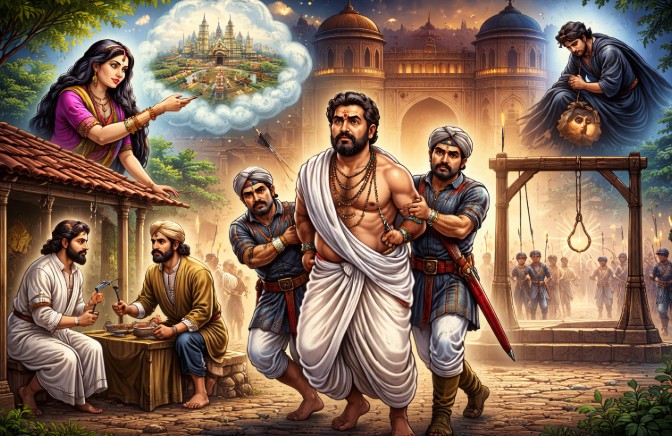
That very night the king’s son was beheaded. The killer ran with the head of the king’s son towards the inn. The Royal soldiers were giving him a hot chase. The killer hid the dead prince’s head in the clothes belonging to the Brahmin and scaled over the wall and ran away.
The king’s men also entered the inn while chasing the killer. They suspected the killer to be hiding in the inn. So they laid a siege and started searching it. Hearing the noise, the Brahmin woke up. He had already been gripped with the fear of impending death. On seeing the Royal soldiers, the Brahmin took to his heels. The soldiers grabbed him. When a thorough search of the Brahmin’s belongings was made, they discovered the prince’s severed head. The Royal soldiers took the Brahmin to the king’s court.
The Brahmin was produced before the king. On the basis of available evidence, the king convicted the Brahmin for the murder of his son. Hence he pronounced death sentence for the Brahmin by hanging.
The king’s prime minister knew the actual plotters. But he dared not name them in the court so openly. He was convinced that the Brahmin was innocent and not guilty of the murder. So he told the hangman to use soft thread to hang the Brahmin. It was a custom in olden days to forgive and spare the life of the person to be executed if the rope used for hanging him gave way.
When the Brahmin was hanged the thread did not give way, as it was ordained by God and the Brahmin died. Such was his fate, which was indomitable.
© Kashmir News Trust (KNT). Unauthorized use without attribution is prohibited.