Trump Faces Mass ‘No Kings’ Protests Over Iran War, Immigration Crackdown Across US, Europe

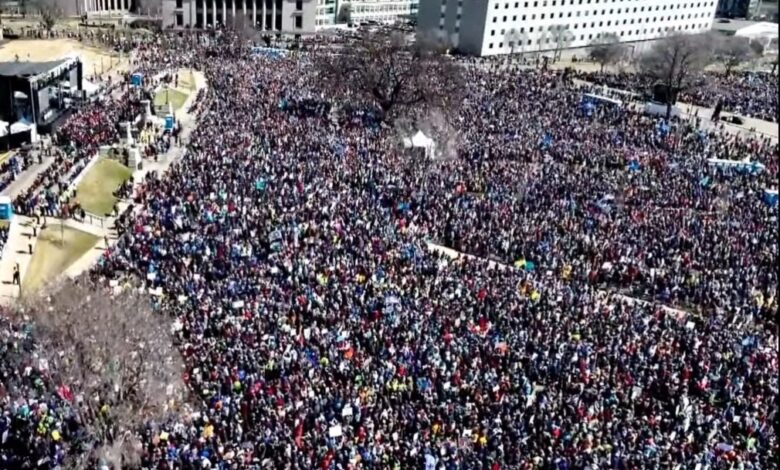
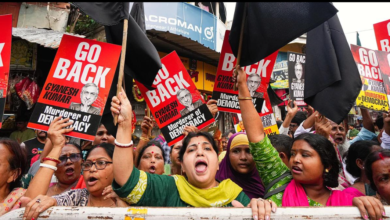
Crowds of protesters rallied across the United States and parts of Europe on Saturday in coordinated “No Kings” demonstrations opposing the war in Iran and President Donald Trump’s policies, with Minnesota emerging as the focal point of what organizers described as a mass mobilization.
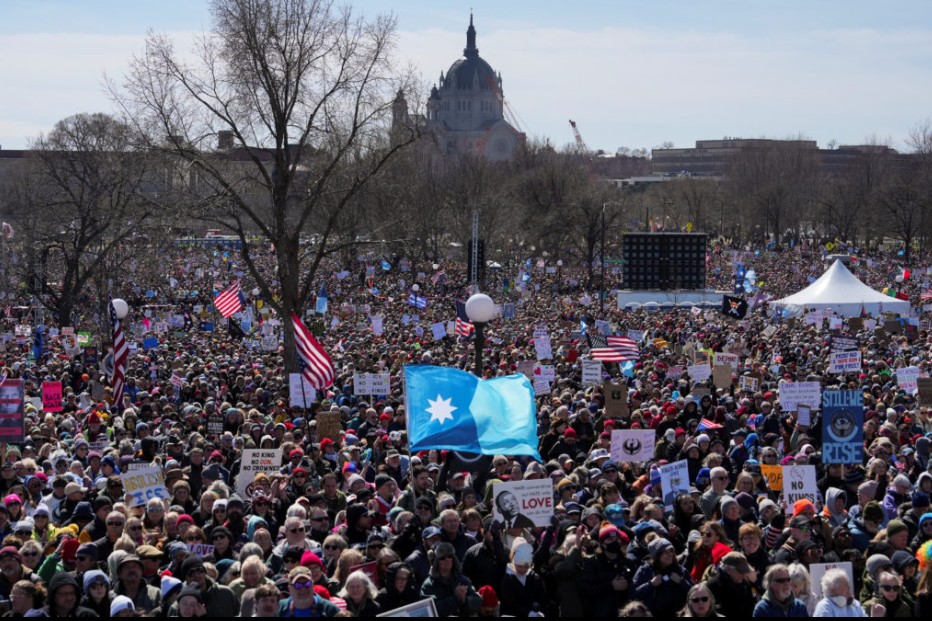
Thousands gathered at the Minnesota Capitol in St. Paul, filling the lawn and surrounding streets. Many held upside-down US flags, a historic signal of distress, as demonstrators voiced opposition to federal immigration enforcement and recent military actions.
The protests marked one of the largest coordinated anti-government demonstrations in recent months, with organizers claiming participation could reach up to 9 million people across more than 3,100 events nationwide. While final turnout figures were not immediately available, previous rounds in June and October had drawn an estimated 5 million and 7 million participants respectively.
The rallies reflect growing dissent over the Trump administration’s domestic and foreign policies, particularly its aggressive immigration enforcement measures and involvement in the Iran conflict. Demonstrations were reported in all 50 US states, spanning major cities and smaller conservative-leaning communities.
Musician Bruce Springsteen headlined the Minnesota event, performing a new song, “Streets of Minneapolis,” written in response to the fatal shootings of Renee Good and Alex Pretti by federal agents. Addressing the crowd, Springsteen criticized federal actions and praised local resistance.
“Your strength and your commitment told us that this was still America,” Springsteen said. “And this reactionary nightmare, and these invasions of American cities, will not stand.”
Protests extended from large urban centres such as New York City to smaller towns like Driggs, Idaho. In Topeka, Kansas, demonstrators staged satirical performances mocking Trump, while in Washington, hundreds marched from the Lincoln Memorial to the National Mall, chanting “No kings” and carrying anti-government slogans.
In San Diego, about 40,000 people participated in a march, according to local police. Organizers said a significant portion of attendees came from suburban and rural areas, including traditionally Republican states such as Wyoming, Utah and Louisiana.
Criticism from the administration and Republican leaders was swift. White House spokesperson Abigail Jackson dismissed the demonstrations as driven by “leftist funding networks” with limited public backing.
“The only people who care about these Trump Derangement Therapy Sessions are the reporters who are paid to cover them,” Jackson said in a statement.
The National Republican Congressional Committee also condemned the rallies. Spokesperson Maureen O’Toole described them as platforms for “the far-left’s most violent, deranged fantasies.”
Despite the criticism, protest leaders and civil rights advocates said the demonstrations signalled widespread concern over democratic norms. Donna Lieberman, executive director of the New York Civil Liberties Union, said the protests were aimed at countering fear.
“They want us to be afraid that there’s nothing we can do to stop them,” Lieberman said. “But you know what? They are wrong — dead wrong.”
Internationally, solidarity protests were reported in several countries. In Rome, thousands marched against the Italian government and the Iran conflict, while in London demonstrators carried banners opposing far-right politics and war.
In Paris, several hundred people, including American expatriates and French activists, gathered at the Bastille. Ada Shen, a local organiser, said participants were protesting what she described as unlawful and prolonged military engagements.
“I protest all of Trump’s illegal, immoral, reckless, and feckless, endless wars,” Shen said.
Organizers said similar events were planned across Europe, Latin America and Australia, with adapted slogans such as “No Tyrants” in constitutional monarchies.
The Minnesota rally was designated the national flagship event, following recent tensions in the state linked to federal enforcement actions. An earlier protest in June had drawn about 80,000 participants, with organisers expecting around 100,000 on Saturday.
The event also featured appearances from activist figures, lawmakers and entertainers, underscoring the breadth of support for the movement.
© Kashmir News Trust (KNT). Unauthorized use without attribution is prohibited.