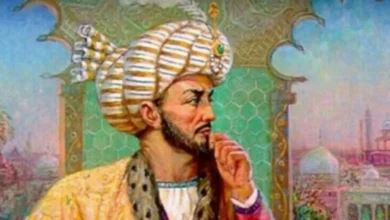
Muhammad Bin Qasim: The Story That Changed the Fate of Sindh

It began with a journey of grief.
After losing their parents in a foreign land, a group of Muslim orphan women were sent by the king of Sri Lanka to the Arab governor of Iraq, hoping they would find safety and protection.
But fate had other plans.
As their ship sailed past the coast of Sindh, pirates attacked. The helpless women were taken captive, their cries lost in the vast waters of the Arabian Sea.
When news reached the powerful governor, Al-Hajjaj ibn Yusuf, he was furious.
He sent a message to Raja Dahir, demanding the rescue of the women.
Dahir’s reply was cold and helpless: he had no control over pirates in the open sea.
That answer changed history.
Enraged, Hajjaj decided to act. He chose his young and ambitious nephew, Muhammad bin Qasim, barely 17 years old, to lead an army into Sindh.
What followed was swift and decisive.
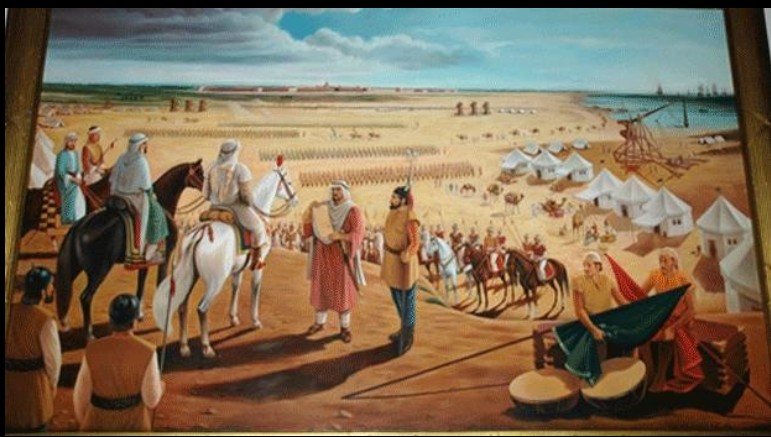
Qasim’s forces stormed the port of Debal, marched inland, and ultimately defeated Raja Dahir in battle. Sindh and later Multan fell under his command, marking the beginning of a new political chapter in the region.
But the story did not end there.
According to popular tradition, Dahir’s daughters were captured and sent to Baghdad. Burning with revenge, they accused Muhammad bin Qasim of dishonouring them.
The accusation shocked the court.
Without investigation, the governor ordered a brutal punishment — Qasim was stitched inside a bag and sent back. By the time it was opened, the young conqueror was dead.
Then came the twist.
The daughters revealed the truth: Qasim was innocent. Their accusation had been a calculated act of revenge for their father’s death.
The revelation sealed their own fate — they were executed.
Muhammad bin Qasim, just 18, became both a conqueror and a tragic figure in history.
His campaign reshaped Sindh forever. While many credit him with establishing Muslim rule in the region, history also reminds us that Islam had already arrived through traders long before his army set foot on the land.
What remains is a story — of power, revenge, youth, and a moment that altered the course of the subcontinent.
Muhammad bin Qasim and the Conquest of Sindh: History and Debate
The Arab conquest of Sindh in 711–712 CE under Muhammad bin Qasim is a well-documented historical event, though several narratives associated with it remain debated.
One commonly cited account, recorded in texts such as the Chachnama, states that a ship carrying Muslim passengers — including women — was attacked by pirates near the Sindh coast. The governor of Iraq, Al-Hajjaj ibn Yusuf, reportedly demanded action from Raja Dahir.
Dahir is said to have responded that he could not control piracy in the open sea. While this episode is frequently presented as the trigger for the invasion, historians note that political expansion and control of trade routes were likely major underlying factors.
Muhammad bin Qasim, a young general in his late teens, led a structured military campaign. He captured Debal, defeated Raja Dahir, and brought Sindh and Multan under Umayyad control.
Historical evidence suggests that after the conquest, local Hindu and Buddhist populations were allowed to continue their religious practices under a taxation system. Administrative continuity was maintained in several areas, indicating a pragmatic governance approach.
The widely circulated story of Raja Dahir’s daughters accusing Muhammad bin Qasim and causing his execution is considered by many historians to be a later literary narrative rather than a confirmed historical fact.
More credible accounts suggest that Muhammad bin Qasim was recalled after political changes within the Umayyad Caliphate and likely died in captivity, though details remain uncertain.
It is also important to note that Islam had reached parts of the Indian subcontinent, particularly the western coast, through Arab traders prior to this campaign.
Therefore, Muhammad bin Qasim’s role is best understood as establishing political rule, rather than introducing Islam to the region for the first time.
His legacy continues to be interpreted through both historical evidence and evolving narratives, reflecting the complex nature of early medieval history in South Asia.
© Kashmir News Trust (KNT). Unauthorized use without attribution is prohibited.