
Dogra rule in Kashmir began in 1846 and lasted for more than a century, shaping the Valley’s politics, economy and society until the partition of the subcontinent in 1947. Unlike Afghan and Sikh administrations, Dogra authority emerged through a political transaction that left a lasting psychological impact on Kashmiri memory. For many, the period began with a sense of dispossession and evolved into an era remembered for heavy taxation, forced labor, social inequality and eventual political awakening.
The foundation of Dogra rule lay in the aftermath of the First Anglo-Sikh War.
The Sikh Empire had weakened after Maharaja Ranjit Singh’s death, and British expansion into northern India altered regional politics. Following Sikh defeat, the Treaty of Lahore was signed in 1846. Soon afterward, the Treaty of Amritsar transferred Kashmir to Gulab Singh, the Dogra ruler of Jammu, in exchange for seventy-five lakh Nanakshahi rupees.
This arrangement became one of the most controversial episodes in Kashmiri history.
The transaction gave rise to a deeply rooted sentiment that Kashmir and its people had effectively been “sold.” While legally framed as a transfer of territory and sovereignty between rulers, the emotional memory of sale remained powerful among Kashmiris and later became central to political discourse.
Gulab Singh thus became the first Dogra Maharaja of Jammu and Kashmir.
The princely state created under Dogra rule was geographically vast and diverse, encompassing Kashmir Valley, Jammu, Ladakh and frontier territories. Yet governing this large and difficult terrain required resources, military control and administrative discipline.
These priorities shaped the character of Dogra administration.
Revenue collection remained central.
Agriculture formed the backbone of the Kashmiri economy, and peasants bore the heaviest burden of taxation. Historical records and later studies indicate that cultivators often surrendered substantial portions of produce to the state. Taxes were imposed on crops and land, leaving rural households vulnerable to poverty and debt.
For ordinary peasants, survival remained uncertain.
Poor harvests or natural disasters could rapidly become catastrophes when revenue demands remained unchanged. Many families lived on narrow margins, and complaints regarding official extraction became widespread.
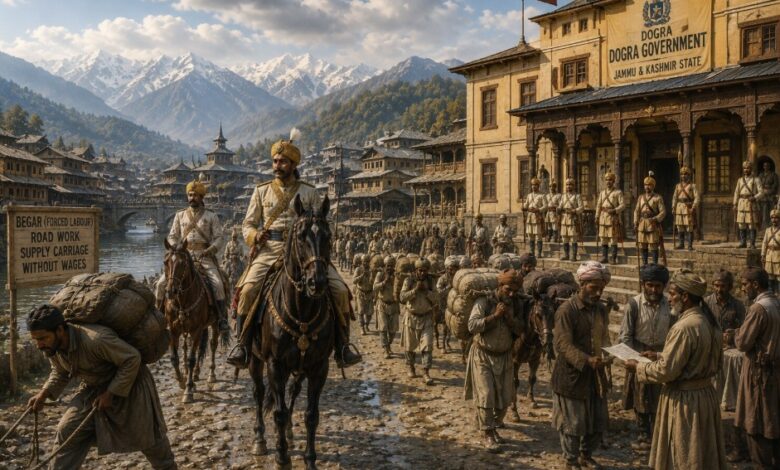
Among the most resented practices associated with Dogra rule was begar, or forced labor.
Begar involved compelling people to transport goods, supplies and official baggage, particularly across mountainous routes connecting Kashmir with frontier regions. Villagers were often required to leave homes and farms to serve state demands without adequate payment.
Read: Kashmir Under the Sikhs: Tax Burdens and Religious Restrictions
Historical accounts describe how laborers endured exhausting journeys carrying supplies through dangerous terrain and severe weather. The burden fell disproportionately upon poorer populations, creating enduring resentment.
Begar became more than an administrative system; it became a symbol of subordination.
Travelers and observers including Walter Lawrence later documented popular complaints regarding forced labor and rural hardship. For many Kashmiris, begar represented the unequal relationship between ruler and subject.
Economic exploitation also affected urban populations.
Kashmir’s renowned shawl industry continued under Dogra administration but faced increasing pressure. The shawl trade had long generated wealth, yet artisans rarely enjoyed its benefits. Taxes imposed upon production and trade strained workers already living under difficult conditions.
Discontent among shawl workers eventually erupted into one of the most significant incidents of the nineteenth century.
In 1865, shawl weavers protesting oppressive taxation and harsh conditions gathered in Srinagar. Dogra forces responded forcefully, and numerous protesters were killed in what later became known as the Zaldagar massacre.
The incident left a profound mark on Kashmir’s labor history.
For many historians, the massacre illustrated the limits of protest under princely authority and highlighted the unequal economic order prevailing in Kashmir.
Religious policy under Dogra rule also remains heavily debated.
Because the rulers were Hindu while the Valley possessed a Muslim majority population, questions of representation and religious sensitivity carried considerable political importance.
Cow slaughter was prohibited under Dogra administration, reflecting Hindu religious considerations and state policy. Historical accounts indicate that violations could attract severe punishment, sometimes including long imprisonment and, in certain reported cases during earlier periods, even capital punishment.
Such policies became controversial among Muslims for whom cattle slaughter formed part of customary dietary and social practice.
Political power likewise remained concentrated.
Muslims, despite forming the demographic majority in Kashmir Valley, possessed limited access to higher administrative positions during significant periods of Dogra rule. Education, government employment and political influence often remained unevenly distributed.
This imbalance increasingly generated dissatisfaction.
The nineteenth century also brought humanitarian crisis.
Read: Autocratic Yet Development-Oriented: Reassessing Dogra-Era Contributions to Kashmir’s Society
The famine of 1877–79 ranks among the darkest chapters of Dogra-era Kashmir. Crop failures, harsh winter conditions and administrative inadequacies contributed to large-scale suffering. Historical estimates vary, but many accounts describe extensive mortality, migration and distress.
Villages were devastated.
Families struggled to obtain food, and famine memory endured long after immediate conditions improved. Critics later argued that taxation policies and inadequate relief aggravated suffering.
Yet Dogra rule cannot be understood solely through repression.
The administration also participated in processes of state formation and modernization.
Road construction gradually improved connectivity between regions. Administrative institutions expanded, and legal systems became more formalized. Maharaja Ranbir Singh introduced the Ranbir Penal Code, creating a codified legal framework modeled partly on British Indian law.
Communication networks, revenue records and bureaucracy developed more systematically than in earlier periods.
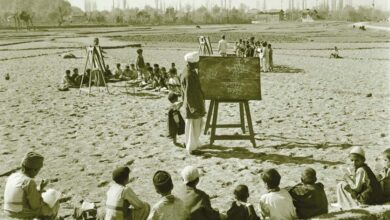
Education, though limited and uneven, slowly expanded.
These developments did not erase inequality, but they altered the nature of governance and state power.
By the early twentieth century, new social and political consciousness had emerged.
Educated Kashmiris increasingly questioned structures of exclusion and inequality. Newspapers, reform movements and political discussion widened public awareness.
The turning point came during the 1930s.
Growing dissatisfaction among Muslims regarding employment, taxation and political representation culminated in organized protest. The events of 1931 became especially significant, marking the rise of mass political mobilization in Kashmir.
The Dogra state now confronted not merely scattered grievance but organized political challenge.
Demands for representation, reform and civil rights gained momentum. Leaders emerged, public meetings increased and the political future of Kashmir became increasingly contested.
Maharaja Hari Singh, the last Dogra ruler, inherited this changing environment.
Unlike earlier decades when princely authority remained relatively secure, the final phase of Dogra rule unfolded amid rising nationalism, communal tensions and British withdrawal from India.
By 1947, partition transformed the political landscape entirely.
The end of British rule, tribal invasion and competing claims over Kashmir triggered a new and turbulent chapter. Dogra authority weakened rapidly as war and political upheaval engulfed the region.
Thus ended more than a century of Dogra rule.
Its legacy remains deeply contested.
For many Kashmiris, the era symbolizes forced labor, unequal power and economic hardship. For others, it also represents state formation, legal development and early modernization.
Yet one reality remains difficult to ignore: Dogra rule shaped modern Kashmir more profoundly and for a longer duration than either Afghan or Sikh administration. It left behind institutions, grievances and political memories that continued to influence Kashmir long after the Maharajas disappeared from power.
© Kashmir News Trust (KNT). Unauthorized use without attribution is prohibited.