
NEWS AGENCY KASHMIR NEWS TRUST #KNT
© Kashmir News Trust (KNT). Unauthorized use without attribution is prohibited.
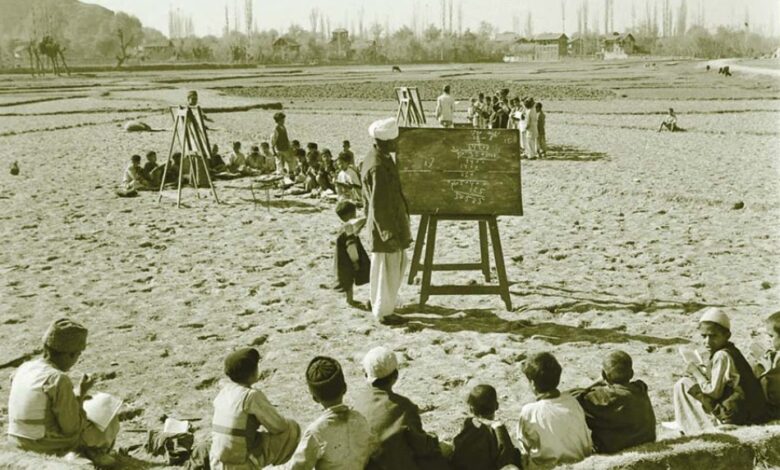
In the early 30’s, Maharaja Hari Singh opened schools across the State. Education was made compulsory. This order was implemented in letter and spirit. Government officials would search for children and take them to school.
Muhammad Yusuf Khan, who played a vital role in revival of the Muslim Conference stated: “I belonged to a family of weavers. A master craftsman in our locality taught me the art of weaving. But, one day I was taken to the school by my scared parents. The school authorities gave me cloth for kameez-pyjama (shirt and trousers). I was also given one rupee to get it stitched. They also gave me books printed in England and a bundle of stationery items. Back home, my parents were delighted to see the cloth and the money I had brought. The books and stationery did not amuse them much.”
Khan later graduated from SP College and served the State Government in various capacities. But for Maharaja Hari Singh’s Jabri (compulsory) schools Khan and an entire generation would have stayed illiterate.
Some people criticize Hari Singh for forcing the people to send their children to schools. However, a peep into history bails him out. Much before Hari Singh’s Jabri schools, Mirwaiz Rasool Shah also opened a school but it attracted few people. This must be the reason behind Hari Singh’s idea of using force. What would he (Hari Singh) gain by such a venture? The question merits serious consideration.
Hari Singh wanted his subjects to read, write and compete with their counterparts in rest of the world. Qudrutullah Shuhab writes in his Shuhab Nama: “When I secured first position in an essay competition, Maharaja Hari Singh invited me to his palace over a cup of tea.” The idea behind this invitation was to encourage him. Shuhab served the Government of Pakistan in a senior capacity till his retirement.
Taken from Zahir-ud-Din’s book “Flash Back: Kashmir Story Since 1846.”
© Kashmir News Trust (KNT). Unauthorized use without attribution is prohibited.