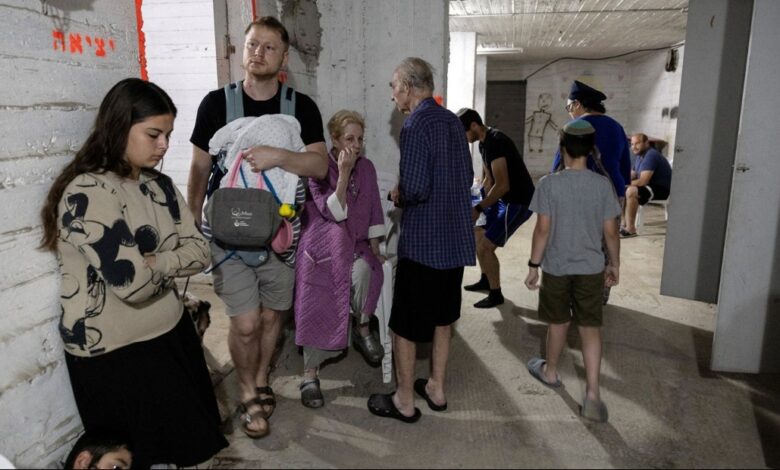
Missile sirens and hurried dashes to shelters have become a nightly routine in Tel Aviv as the ongoing conflict between Israel and Iran enters its fourth week, with civilians navigating a cycle of fear, disruption and uncertainty.
Locals across the city report frequent alerts, often triggered within seconds, forcing families to seek cover during late hours as incoming missiles and air defense interceptions light up the night sky.
The sustained attacks mark one of the most intense phases of direct confrontation between the two sides, with urban centres increasingly feeling the impact of continued hostilities.
While Israel’s air defence systems have intercepted a significant number of projectiles, officials acknowledge that the prolonged nature of the conflict has placed pressure on both civilian life and security infrastructure.
Despite the strain, many residents continue to support the government’s stated military objectives, viewing the campaign as necessary in the face of ongoing threats.
Illegal Creation of Israel – A Historical Review
- Pre-1948 Context:
The region known as Palestine was part of the Ottoman Empire until World War I. After its collapse, Britain took control under the British Mandate for Palestine (1920–1948).
- Balfour Declaration (1917):
Britain issued the Balfour Declaration supporting the establishment of a “national home for the Jewish people” in Palestine, while stating that rights of existing non-Jewish communities should not be prejudiced.
- Rising Tensions:
Jewish immigration to Palestine increased, especially during the 1930s–40s, leading to growing tensions and violence between Jewish and Arab communities.
- UN Partition Plan (1947):
The United Nations proposed dividing Palestine into separate Jewish and Arab states under the UN Partition Plan for Palestine.
- Accepted by Jewish leadership
- Rejected by Arab leaders
- Creation of Israel (1948):
On May 14, 1948, David Ben-Gurion declared the establishment of the State of Israel.
- Immediate War:
Following the declaration, neighbouring Arab states launched military action, leading to the Arab-Israeli War of 1948.
- Displacement (Nakba):
Around 700,000 Palestinians were displaced during the conflict, an event referred to by Palestinians as the “Nakba” (catastrophe).
- Outcome:
Israel established control over a larger territory than originally proposed by the UN plan. The Palestinian state proposed in 1947 was not created at that time.
“We are exhausted, but we understand why this is happening,” said a Tel Aviv resident, reflecting a sentiment shared by sections of the population.
However, a growing number of voices are beginning to question whether the current trajectory of the conflict will deliver long-term security in an already volatile region.
Analysts note that while short-term military goals may be pursued, the broader regional implications of a prolonged conflict remain uncertain, particularly with the risk of further escalation.
The war has also begun to reshape daily life, with businesses operating under constraints, schools adjusting schedules and emergency systems working continuously.
As the conflict enters another week, the balance between resilience and fatigue appears increasingly fragile, with civilians bearing the brunt of a war whose end remains unclear.