Nine Years After High Court Order, Untreated Sewage Still Pollutes Sindh Nallah at Sonamarg

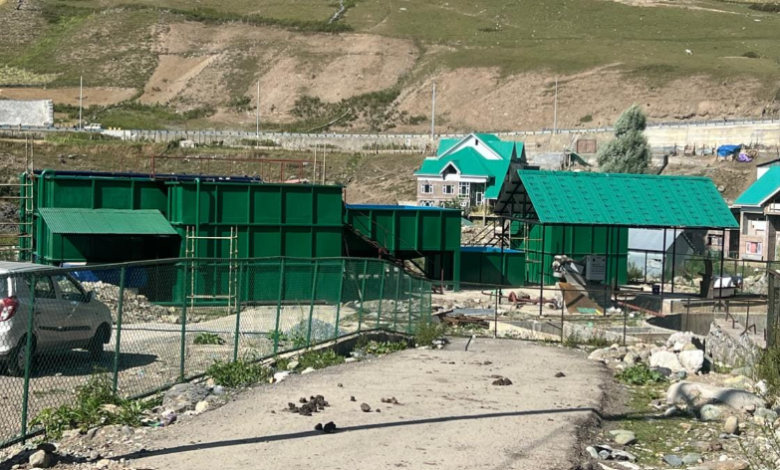
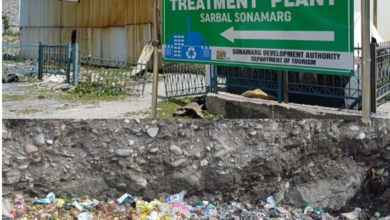
Ganderbal, Sep 16, KNT: Nearly nine years after the High Court directed authorities to establish a common sewage treatment plant at Sonamarg to prevent untreated sewage from entering the Sindh Nallah, fresh Central Pollution Control Board (CPCB) testing has found sewage-related contamination in the water body, raising questions over the pace and effectiveness of measures taken to protect the river.
The latest CPCB assessment, based on samples collected on May 4, 2026, found that three locations in the Sindh Nallah, including a site at Sonamarg and another downstream of Shutkadi Bridge, failed to meet the prescribed Class B and Class C criteria because of elevated total coliform levels.
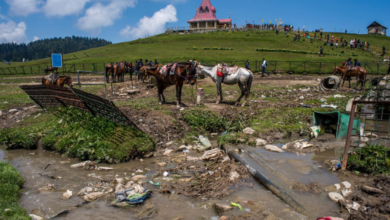
The pollution levels were considerably higher in drains feeding the nallah. The CPCB recorded faecal-coliform concentrations ranging from 2×10⁴ to 29×10⁷ MPN per 100 millilitres in four drains examined during the assessment, with biochemical oxygen demand levels ranging from 6 mg/litre to 118 mg/litre, indicating the presence of untreated sewage.
A drain near Hotel Glacier/Tajwas in Sonamarg recorded the highest contamination, with faecal coliform reported at 29×10⁷ MPN per 100 millilitres and total coliform at 35×10⁸ MPN per 100 millilitres. The CPCB linked the deterioration in water quality at the affected river locations to sewage-laden drains entering the Sindh Nallah.
The findings assume significance because the issue is not new.
In September 2017, the Jammu and Kashmir High Court had directed the Sonamarg Development Authority to establish a common sewage treatment plant at the tourist resort so that untreated sewage did not flow directly into the Sindh. The court had also directed authorities to ensure proper management of solid waste and other non-biodegradable waste in and around Sonamarg.
Yet the latest CPCB inspection found that the sewage-treatment infrastructure intended for Sonamarg was still under construction. The CPCB/NGT record describes a 1.2 million litres per day (MLD) STP based on MBBR technology and records that the Sonamarg Development Authority informed the inspection team that installation would require additional time.
More significantly, the CPCB record states that the Authority had not obtained the mandatory Consent to Establish from the J&K Pollution Control Committee for the project at the time of the assessment.
The latest findings therefore raise questions over the gap between environmental commitments and actual protection of the Sindh Nallah, particularly as Sonamarg continues to receive large numbers of tourists and hosts hotels, restaurants, markets and other commercial establishments.
The government has also been pursuing wider waste-management measures in Sonamarg. The Tourism Development Authority issued directions earlier this year requiring hotels, guest houses, restaurants, shopkeepers and other operators to comply with waste-segregation and disposal requirements in accordance with environmental regulations.
The CPCB has recommended that the concerned authorities ensure that sewage is properly treated before discharge into the Sindh Nallah and that regular monitoring be undertaken to prevent further deterioration of water quality.
The issue is now before the National Green Tribunal in proceedings concerning pollution of the Sindh Nallah and its potential impact on the region’s trout habitat. [KNT]
© Kashmir News Trust (KNT). Unauthorized use without attribution is prohibited.