Qin Shi Huang and the “Burning of Books and Burying of Scholars”

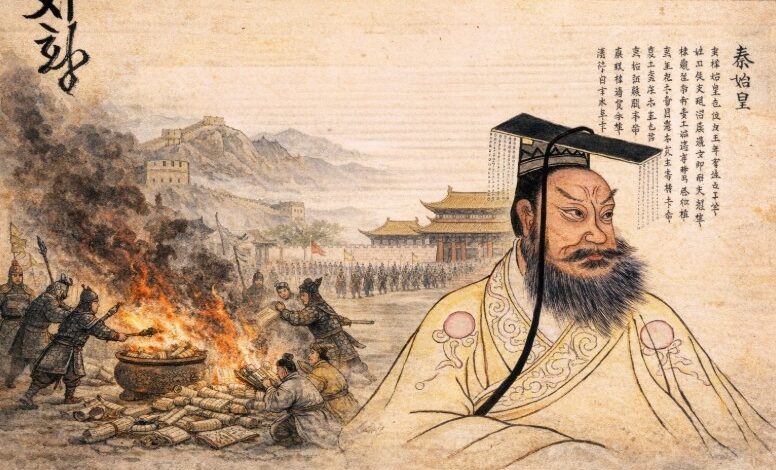
The episode commonly known as “Burning of Books and Burying of Scholars” refers to policies carried out under Qin Shi Huang, founder of the Qin dynasty (221–206 BCE). It occurred mainly in 213 BCE (book burning) and 212 BCE (executions/burials) in the Qin capital Xianyang (near modern Xi’an, Shaanxi).
Below is a complete, structured account covering why, when, how, where, and what it meant.
1. Historical Background
Before unification, China had been divided during the Warring States period (475–221 BCE). Rival states promoted different philosophies:
-
Confucianism (moral governance, reverence for antiquity)
-
Legalism (strict laws, centralized authority)
-
Daoism
-
Mohism and others
After defeating all rivals, Qin Shi Huang sought total political, cultural, and ideological unity. He standardized:
-
Script (small seal script)
-
Weights and measures
-
Currency
-
Axle widths for carts
-
Administrative systems
His chief minister Li Si, a Legalist, shaped the ideological crackdown.
2. Why Did He Order the Book Burning?
A. Political Control and Ideological Uniformity
Legalism argued that:
-
The ruler’s authority must be absolute.
-
The past should not be used to criticize the present.
-
Scholars who cited ancient rulers undermined current power.
Confucian scholars frequently compared Qin rule unfavorably to earlier dynasties, especially the Zhou. Li Si argued this created dissent.
B. Preventing Political Opposition
Private possession of historical texts allowed elites to:
-
Debate state policies
-
Invoke past precedents to resist reform
-
Promote rival ideologies
Qin Shi Huang wanted intellectual centralization to match political centralization.
C. Erasing Rival Legitimacy
The emperor saw himself as the beginning of a new era. He abolished traditional feudal titles and sought to:
-
Break continuity with the Zhou feudal past
-
Prevent alternative visions of governance
This is often described as an attempt to “bury the past.”
3. What Exactly Was Burned?
In 213 BCE, following Li Si’s memorial:
Ordered Destroyed:
-
Historical records of other states (except Qin’s own history)
-
Confucian classics
-
Philosophical works not aligned with Legalism
-
Private copies of banned texts
Allowed:
-
Books on medicine
-
Agriculture
-
Forestry
-
Divination
-
Official Qin archives (state-controlled copies)
Officials were ordered to confiscate prohibited books. Failure to comply could result in severe punishment.
4. How Was It Carried Out?
-
An imperial edict was issued.
-
Local officials collected banned texts.
-
Confiscated materials were burned publicly.
-
Those discussing banned texts could face punishment.
-
Repeat offenders were reportedly sent to forced labor on projects like the Great Wall.
Enforcement likely varied regionally.
5. The “Burying of Scholars” (212 BCE)
A year later, a separate but related event occurred.
According to the historian Sima Qian in the Records of the Grand Historian (Shiji):
-
Around 460 scholars were executed (traditionally said to be buried alive).
-
They were accused of criticizing the emperor or engaging in forbidden practices.
-
Some were allegedly court alchemists who failed to deliver immortality elixirs.
Modern Scholarly Debate
Historians debate:
-
Whether they were truly buried alive.
-
Whether the victims were mainly Confucians.
-
Whether the number 460 was symbolic exaggeration.
-
Whether the Han dynasty later amplified the story to discredit Qin rule.
The Han dynasty promoted Confucianism and had political motive to portray Qin as tyrannical.
6. Why Punish Those Who Saved Books?
Saving banned books meant:
-
Disobedience of imperial edict
-
Preservation of rival ideology
-
Potential political resistance
-
Undermining centralized authority
Under Legalist philosophy:
-
Law was supreme.
-
Punishment deterred dissent.
-
Individual moral conviction did not override state authority.
Thus, preserving old texts was not seen as cultural loyalty but as political defiance.
7. Where Did This Occur?
Primary center:
-
Xianyang, Qin capital
But enforcement spread across:
-
Former territories of conquered states
-
Administrative commanderies throughout the empire
8. Consequences
Short-Term
-
Strengthened centralized control.
-
Reduced intellectual pluralism.
-
Intensified fear among elites.
Long-Term
-
Qin dynasty collapsed just four years after Qin Shi Huang’s death.
-
Han dynasty restored many classical texts.
-
Confucianism became state orthodoxy under Emperor Wu of Han.
-
The book burning became a symbol of authoritarian suppression.
9. Did It Truly Destroy All Knowledge?
No.
Reasons:
-
Some texts survived in hidden copies.
-
Scholars memorized classics.
-
Han scholars reconstructed texts.
-
Qin allowed practical manuals to survive.
Many Confucian classics were later recovered.
10. Was He Trying to Erase History Completely?
Not exactly.
He did not destroy:
-
Qin’s own official records.
-
Administrative documentation.
Rather, he attempted:
-
To control historical narrative.
-
To prevent use of history as political criticism.
-
To establish ideological monopoly.
11. Modern Historical Interpretation
Modern historians view the event as:
-
Partly historical fact
-
Possibly exaggerated by Han historians
-
A reflection of Legalist authoritarian statecraft
-
A major turning point in Chinese intellectual history
It symbolizes tension between:
-
Central authority vs. intellectual freedom
-
Law vs. moral tradition
-
State power vs. cultural memory
Final Summary
In 213–212 BCE, Qin Shi Huang, guided by Legalist principles and Chancellor Li Si, ordered the destruction of non-Qin historical and philosophical texts and executed hundreds of scholars. The aim was not random destruction but ideological control, political security, and cultural unification. Those who preserved banned books were punished because they represented resistance to centralized authority.