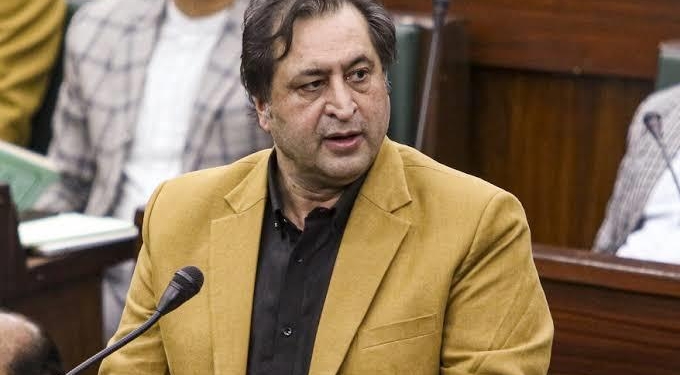
Jammu, March 30, KNT: Peoples Conference President and MLA Handwara Sajad Lone on Monday raised concerns in the Jammu and Kashmir Assembly over what he described as inconsistencies in defining economic vulnerability across government departments, calling it a structural issue affecting fairness in employment and welfare distribution.
The remarks come amid ongoing debates over reservation frameworks and job distribution, particularly under the Economically Weaker Sections (EWS) category.
Speaking in the House, Lone cited official data to argue that varying definitions of poverty across departments were creating contradictions with significant policy implications.
He said the Food Department identifies nearly 39 lakh people in Kashmir and 27 lakh in Jammu as poor under Below Poverty Line (BPL) and Antyodaya Anna Yojana (AAY) categories.
“In contrast, the Social Welfare framework presents an inverse picture, where 90% in Jammu are classified as economically weak compared to just 10% in Kashmir,” Lone said, terming the divergence a policy failure rather than a statistical anomaly.
He argued that the mismatch in definitions was impacting outcomes in recruitment processes, including selections for judicial services and the Jammu and Kashmir Administrative Service (KAS).
“Such disparities have never been witnessed historically since 1947,” Lone said, adding that the inconsistency was disadvantaging candidates from Kashmir in the EWS quota despite ground-level indicators suggesting otherwise.
Questioning the logic of the system, Lone said, “What kind of governance is this, where a person is poor when receiving rations or subsidies, but suddenly becomes ‘rich’ when applying for a job?”
He said the dual classification undermines both fairness and administrative coherence.
Referring to the government’s announcement of around 30,000 upcoming jobs, Lone warned that under the existing EWS framework, only a small fraction of positions may go to candidates from Kashmir.
He said that if BPL data were considered, the distribution could justify a higher share for Kashmir, suggesting a possible 60:40 ratio.
Lone also cited examples from other states, including Kerala, where EWS criteria have been aligned with broader poverty indicators to ensure consistency.
Rejecting the need for a complete legislative overhaul, he instead called for policy standardisation across departments.
“One government must have one definition,” Lone said, stressing that coherence in identifying economic vulnerability is essential for equitable governance. [KNT]