Introduction
The Black Hole of Calcutta remains one of the most debated and emotionally charged incidents in early colonial Indian history. Associated with the capture of Calcutta by Siraj ud-Daulah in June 1756, the episode has been variously described as a tragic accident, an administrative failure, and a piece of imperial propaganda. Its historical interpretation has evolved significantly over time, making it an essential case study in how narratives are shaped by power, politics and perspective.
Background: Rising Tensions in Bengal
By the mid-18th century, the British East India Company had transformed from a trading enterprise into a political and military force in Bengal.
Key points of conflict included:
-
Unauthorized fortification of Fort William in Calcutta
-
Abuse of trade privileges granted by Mughal authorities
-
Shelter provided to political fugitives opposed to the Nawab
Siraj ud-Daulah, who became Nawab in 1756, viewed these actions as a direct challenge to his authority. Determined to reassert control, he marched on Calcutta.
The Capture of Calcutta
In June 1756, Siraj ud-Daulah’s forces besieged and captured Fort William. Many British officials fled, leaving behind a reduced garrison and civilians. After a brief resistance, the fort fell on 20 June 1756.
Following the capture, surviving British personnel and others were taken into custody.
The “Black Hole” Incident
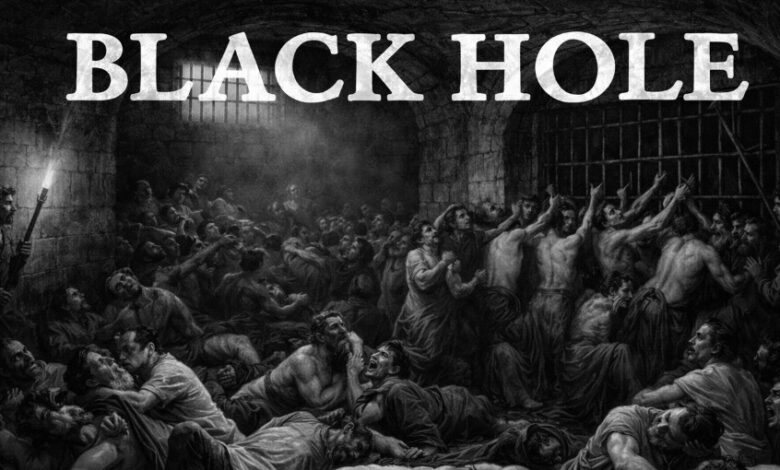
According to the most widely circulated account by John Zephaniah Holwell:
-
Around 146 prisoners were confined in a small guard room measuring roughly 18 by 14 feet
-
The room had minimal ventilation and was ill-equipped to hold such numbers
-
Overnight, prisoners suffered from extreme heat, suffocation, dehydration and panic
-
By morning, only 23 survivors remained
This account gave rise to the term “Black Hole”, symbolizing both the physical space and the scale of the tragedy.
Historical Debate and Reassessment
Modern historians have critically examined Holwell’s narrative and raised several concerns:
-
Exaggeration of numbers: Many scholars argue the number of prisoners was significantly lower
-
Lack of corroboration: Independent contemporary records do not fully support Holwell’s claims
-
Narrative bias: Holwell had a vested interest in portraying the incident dramatically
Today, the incident is generally understood as:
A tragic case of negligent confinement under chaotic post-battle conditions, rather than a deliberate act ordered by the Nawab.
Importantly, there is no strong evidence that Siraj ud-Daulah personally ordered or intended such treatment of prisoners.
Political Impact and British Response
The Black Hole narrative had profound consequences:
-
It generated outrage in Britain
-
It was used to morally justify military retaliation
-
It strengthened the Company’s resolve to expand its political control
Within a year, the Company, led by Robert Clive, defeated Siraj ud-Daulah at the Battle of Plassey.
This marked a decisive turning point, laying the foundation for British colonial dominance in India.
Memory, Monument and Legacy
The British later memorialized the event through monuments in Calcutta, reinforcing its place in colonial memory. However:
-
Post-independence historiography in India re-evaluated the narrative
-
The incident is now often cited as an example of colonial myth-making and selective storytelling
Conclusion
The Black Hole of Calcutta stands at the intersection of history, memory and political narrative. While the suffering of those confined cannot be dismissed, the scale, intent and responsibility remain contested.
For modern readers, the incident is less about a single night in 1756 and more about how history can be shaped, amplified or distorted to serve larger imperial ambitions.