The Three Battles of Panipat
Military Revolution, Imperial Survival, and the Reshaping of North India (1526–1761)
Panipat, located in present-day Haryana about 90 kilometers north of Delhi, became the site of three decisive battles in 1526, 1556, and 1761. Each encounter altered the political trajectory of the subcontinent. The plains of Panipat, positioned on the historic Kabul–Delhi invasion corridor, offered open terrain suitable for mass cavalry formations and artillery deployment. Control of Panipat meant access to Delhi, the symbolic heart of sovereignty in North India.
Across nearly 250 years, Panipat witnessed the fall of the Delhi Sultanate, the survival of the Mughal Empire, and the temporary collapse of Maratha northern ambition. Together, these battles mark the structural transition from Afghan sultanate power to Mughal imperial consolidation and ultimately to eighteenth-century fragmentation that facilitated British expansion.
I. The First Battle of Panipat (21 April 1526)
Principal Figures
• Babur
• Ibrahim Lodi
• Rana Sanga
Political Background: Crisis of the Lodi Sultanate
By the early sixteenth century, the Delhi Sultanate under Ibrahim Lodi was fractured by Afghan factionalism. Ibrahim’s attempts at centralization alienated powerful nobles including Daulat Khan Lodi (Governor of Punjab) and Alam Khan (his uncle). These Afghan dissidents invited Babur, the Timurid ruler of Kabul, to intervene.
Primary evidence from the Baburnama confirms Babur’s engagement with Afghan nobles. His ambition was not a raid but permanent conquest. He viewed Hindustan as both economically attractive and politically claimable due to his Timurid lineage.
The Question of Rana Sanga: Historiographical Debate
The role of Rana Sanga remains debated.
-
The Baburnama does not explicitly state that Sanga invited Babur.
-
Later Mughal chroniclers such as Abu’l Fazl portray Sanga as Babur’s rival.
-
Some nineteenth-century historians suggested Sanga encouraged Babur to weaken the Lodis.
-
Modern scholars such as Satish Chandra and R.C. Majumdar caution that there is no conclusive documentary proof of a formal invitation.
Current academic consensus: Afghan nobles clearly invited Babur. Rana Sanga may have expected to challenge him later but did not participate in the First Battle of Panipat. Their confrontation occurred at the Battle of Khanwa (1527).
Military Forces and Technology
Babur:
-
12,000–15,000 troops
-
Ottoman-style field artillery
-
Matchlock musketeers
-
Tulughma flanking tactics
-
Wagon-laager defensive system (araba)
Ibrahim Lodi:
-
80,000–100,000 soldiers
-
800–1,000 war elephants
-
Heavy cavalry reliance
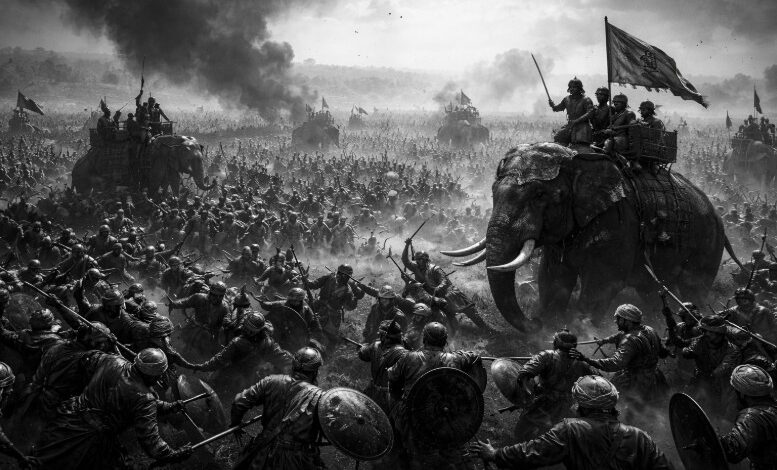
The battle represents what historians call the “Gunpowder Revolution” in India. Cannons panicked war elephants, causing disorder within Lodi ranks. Tactical discipline and artillery coordination overcame numerical inferiority.
Consequences
Immediate:
-
Death of Ibrahim Lodi
-
Collapse of the Delhi Sultanate
-
Capture of Delhi and Agra
Long-term:
-
Establishment of the Mughal Empire
-
Introduction of sustained gunpowder statecraft
-
Beginning of Mughal-Rajput military confrontation
Scholars interpret 1526 not merely as conquest but as the founding of a Timurid-Persianate imperial system in India.
II. The Second Battle of Panipat (5 November 1556)
• Akbar
• Hemu
• Bairam Khan (Regent)
Political Setting: Sur Interregnum
After Babur’s death, Humayun lost the empire to Sher Shah Suri (1540). The Sur dynasty ruled until internal conflicts weakened it. Humayun briefly restored Mughal power in 1555 but died in early 1556.
Akbar, only 13, ascended under Bairam Khan’s regency.
Hemu, a capable general of Afghan Sur remnants, defeated Mughal forces and occupied Delhi, assuming the title Vikramaditya.
Historiographical Views on Hemu
-
Mughal chronicles portray him as a usurper.
-
Nationalist historians depict him as a Hindu revivalist ruler.
-
Modern scholars emphasize his administrative and military skill while rejecting exaggerated nationalist framing.
Military Engagement
Hemu:
-
30,000–40,000 cavalry
-
1,500 elephants
Mughals:
-
20,000–25,000 troops
-
Strong artillery coordination
The turning point came when Hemu was struck in the eye by an arrow. His incapacitation led to army demoralization. According to the Akbarnama, this psychological collapse decided the battle.
Consequences
Immediate:
-
Hemu captured and executed
-
Mughal authority restored
Structural:
-
Consolidation of Mughal administration
-
Foundations of mansabdari system
-
Expansion under Akbar
Historians argue that without Panipat (1556), Mughal imperial continuity may have ended permanently.
III. The Third Battle of Panipat (14 January 1761)
• Ahmad Shah Durrani
• Sadashivrao Bhau
Eighteenth-Century Fragmentation
By mid-1700s:
-
Mughal emperor reduced to symbolic authority
-
Maratha Confederacy expanded northward
-
Punjab contested between Afghans and Marathas
Durrani sought to protect Afghan interests and Rohilla allies. Marathas aimed to dominate Delhi and North India.
Alliances
Durrani:
-
Rohilla Afghans
-
Shuja-ud-Daula (Awadh)
Marathas:
-
Limited northern support
-
Rajputs largely neutral
-
Logistical overextension
Strategic Failures
Historians identify:
-
Long supply lines from Deccan
-
Heavy non-combatant camp followers
-
Poor northern coalition building
-
Afghan mobility superiority
Casualties are estimated between 60,000 and 100,000.
Historiographical Debate
Nationalist View:
-
Catastrophic defeat of indigenous power
Cambridge School:
-
Regional power contest, not national struggle
Revisionist Interpretation:
-
Marathas recovered within a decade
-
British rise linked more directly to Plassey (1757) and Buxar (1764)
Jadunath Sarkar calls it one of the bloodiest battles of eighteenth-century Asia.
Consequences
Immediate:
-
Maratha northern authority collapsed
-
Delhi destabilized
Long-term:
-
Political vacuum in North India
-
British East India Company expanded influence
-
Mughal authority further weakened
Though not solely responsible for British rule, 1761 accelerated fragmentation that the British exploited.
Comparative Structural Impact
| Battle | Structural Outcome | Broader Significance |
|---|---|---|
| 1526 | Afghan Sultanate → Mughal Empire | Gunpowder state formation |
| 1556 | Mughal restoration | Imperial consolidation |
| 1761 | Maratha setback | Eighteenth-century fragmentation |
Conclusion
The three Battles of Panipat were not isolated military events but structural transformations in Indian history.
1526 established Mughal gunpowder sovereignty.
1556 ensured imperial survival and administrative consolidation.
1761 disrupted Maratha northern expansion and accelerated regional fragmentation.
Across two and a half centuries, Panipat became the crucible where political legitimacy, military innovation, and imperial ambition repeatedly collided.
Selected Academic References
Primary Sources:
-
Babur, Baburnama
-
Abu’l Fazl, Akbarnama
-
Firishta, Tarikh-i-Firishta
Modern Scholarship:
-
Satish Chandra, Medieval India
-
R.C. Majumdar, History and Culture of the Indian People
-
Irfan Habib, Agrarian System of Mughal India
-
Jadunath Sarkar, Fall of the Mughal Empire
-
Stephen Dale, The Garden of the Eight Paradises