Long before roads carved through the valley and engines filled the air with noise, Kashmir moved to a quieter rhythm—one set by the flowing waters of the Jhelum.
In those days, Srinagar was not a city of traffic but of boats.
The river was not just water—it was life itself.
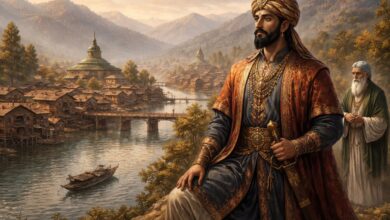
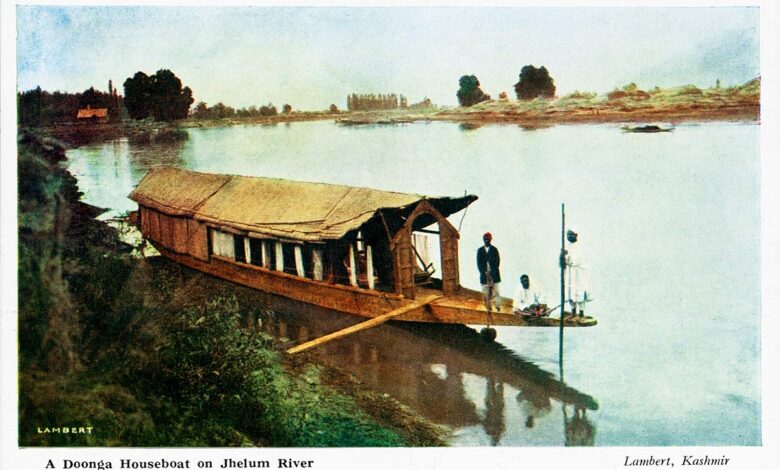
People traveled in long wooden boats called doongas. These weren’t small vessels; entire families lived in them. Kitchens smoked gently at one end, children played in the middle, and elders rested near the carved wooden windows.
A journey from one part of Srinagar to another meant drifting along the Jhelum, passing under its famous wooden bridges—each with its own story, each echoing with footsteps of centuries.
Markets didn’t stand still.
They floated.
Vendors sold vegetables, flowers, and daily goods directly from their boats. Bargaining happened mid-river. Voices carried across water instead of streets.
There were no horns—only the soft splash of oars.
At dawn, the river would come alive in a different way.
Fishermen cast their nets in silence. Women washed clothes along the ghats. The first light of the sun touched the wooden houses, reflecting gently in the water.
It was a world where time moved slowly.
But the Jhelum was not just about livelihood.
It was also a witness.
It saw kings, saints, traders, and invaders pass along its course. It carried stories of prosperity—and also of floods that tested the resilience of the people.
The devastating floods of earlier centuries often submerged parts of Srinagar, yet people rebuilt, again and again, never abandoning the river that defined them.
One of the most remarkable aspects of old Kashmir was how deeply water shaped identity.
Even social life adapted to it.
-
Weddings often involved boat processions
-
Goods were transported almost entirely by water
-
Communication between neighborhoods depended on river routes
The Jhelum was not just geography—
It was culture.
Over time, roads replaced waterways.
Bridges of concrete replaced wood.
Boats gave way to vehicles.
And slowly, the river lost its central role in daily life.
Yet, if you stand quietly on its banks today—early in the morning, before the city fully wakes—you can still feel echoes of that past.
A faint ripple.
A distant call.
A memory carried by water.