
Over $200 Billion Investment Likely in Next Two Years, Says Indian IT Minister Vaishnaw

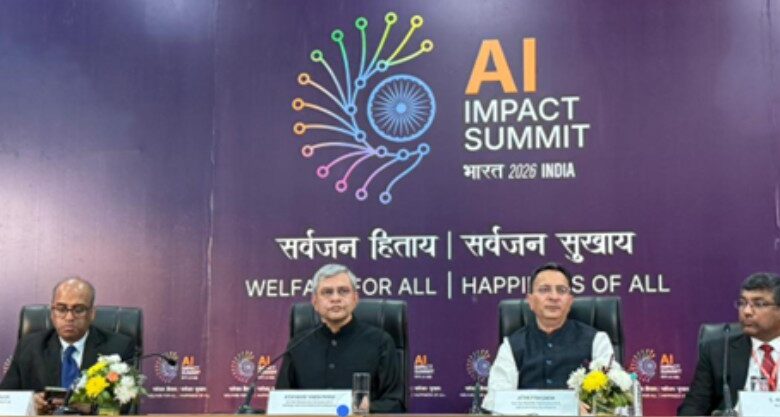
New Delhi, Feb 17, KNT: Indian Union Minister for Electronics and Information Technology Ashwini Vaishnaw on Tuesday announced that India will scale its artificial intelligence compute capacity beyond the existing 38,000 GPUs with the addition of 20,000 more GPUs in the coming weeks, marking the next phase of the country’s AI strategy.
Addressing the media on the second day of the India AI Impact Summit 2026 in New Delhi, the Minister said the expansion represents a significant strengthening of compute infrastructure while maintaining a firm focus on responsible AI development and deployment across sectors such as healthcare and education.
Vaishnaw said the strategy reflects Prime Minister Narendra Modi’s vision of democratizing technology, asserting that India has ensured broader public access to AI compute infrastructure unlike models where control remains concentrated in a few corporations.
The interaction was attended by Minister of State Jitin Prasada, MeitY Secretary S. Krishnan and Abhishek Singh, CEO of the IndiaAI Mission. The Summit, being held from February 16 to 20, has drawn global technology leaders, policymakers, industry stakeholders, startups and students.
Highlighting investment prospects, Vaishnaw expressed optimism that more than $200 billion in investments could flow into the AI ecosystem over the next two years, spanning all five layers of the AI stack. He noted strong participation from venture capital firms supporting deep-tech innovation.
The Minister said work is underway on reskilling and upskilling the existing workforce, building a new talent pipeline and updating academic curricula in collaboration with the Ministry of Education and AICTE. He added that India’s clean energy capacity, with around 51 percent of power generation from non-fossil sources, offers an advantage for sustainable AI data centres.
On sovereign AI models, Vaishnaw said several Indian systems launched at the Summit performed competitively against global benchmarks, with India ranked among the top three AI nations by Stanford assessments.
He also emphasised a techno-legal approach to AI safety, noting that India’s AI Safety Institute is developing safeguards to prevent misuse. The Minister described AI as central to a new industrial transformation, with applications showcased in healthcare and personalized education.
Reaffirming commitment to the Semiconductor Mission, he said Semiconductor 2.0 would prioritise chip design and deep-tech innovation. He also noted that over 2.5 lakh students pledged responsible AI use on the first day of the Summit, an initiative being submitted for Guinness World Records recognition.
Vaishnaw said India remains committed to advancing AI responsibly while ensuring its benefits reach all sections of society. [KNT]
© Kashmir News Trust (KNT). Unauthorized use without attribution is prohibited.