
The story of Rinchin, later known as Sultan Sadr-ud-Din, marks a decisive turning point in Kashmir’s history. It is not merely an account of religious conversion, but a moment shaped by politics, social structure, and the search for legitimacy in early fourteenth-century Kashmir.
From Ladakh to the Throne of Kashmir
Rinchin was a Tibetan–Ladakhi noble who entered Kashmir during a period of deep political instability. The decline of the Lohara dynasty had weakened central authority, and competing factions had created space for new power to emerge. Around 1320 CE, through a combination of military ability and strategic alliances, Rinchin seized control of Srinagar and established himself as ruler.
Yet, despite holding power, he remained an outsider in the eyes of the established social order. Authority without acceptance left his position fragile.
Rejection and the Search for Legitimacy
To strengthen his rule, Rinchin sought recognition from the dominant religious elite of the time, particularly the Brahmin establishment. According to later chronicles, including continuations of the Rajatarangini, he expressed a desire to be initiated into Hinduism.
The request was refused.
This refusal was not a minor episode. It reflected the rigidity of the prevailing social structure, where entry into the religious and caste framework was tightly controlled. For Rinchin, this closed an important path to legitimacy.
The Encounter with Bulbul Shah
At this critical juncture, Rinchin came into contact with the Sufi saint Bulbul Shah, also known as Syed Sharaf-ud-Din Abdur Rahman, who had arrived in Kashmir from Central Asia.
The Sufi approach differed sharply from the exclusivity Rinchin had encountered. It emphasized equality among believers, simplicity in practice, and direct spiritual access without rigid hierarchy. This offered not only a religious alternative, but also a socially inclusive framework.
The Moment of Conversion
Accounts of Rinchin’s conversion vary in detail, but later historical interpretations and narrative traditions, including those discussed by M. J. Akbar in The Vale of Kashmir, provide a more vivid description of the moment.
According to this tradition, Rinchin resolved his uncertainty through a personal test. He is said to have declared that he would follow the first call to faith he encountered at dawn.
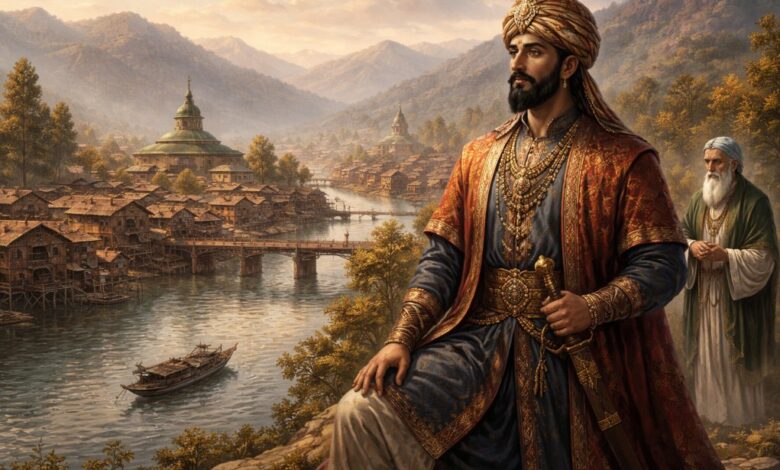
At pre-dawn, when the valley lay silent and the Jhelum flowed through a mist-covered Srinagar, he is believed to have heard a call rise in the stillness:
Allahu Akbar.
It was the azan, the call to prayer.
Drawn by the sound, Rinchin moved toward its source and found Bulbul Shah engaged in prayer. The simplicity of the scene, devoid of ritual complexity or display, is said to have left a deep impression on him.
In that moment, the search ended.
Rinchin accepted Islam and took the name Sultan Sadr-ud-Din.
While this account is not uniformly recorded in the earliest chronicles, it reflects a widely preserved narrative tradition that captures both the symbolic and human dimensions of the event.
A Decision Shaped by Multiple Forces
Rinchin’s conversion cannot be reduced to a single cause. It emerged from a convergence of factors.
He required political legitimacy in a society where he remained an outsider. He faced rejection from the established elite. At the same time, he encountered a religious tradition that offered inclusion without barriers.
The decision, therefore, was both personal and political, shaped by circumstance as much as conviction.
Institutional Beginnings
Following his conversion, Rinchin extended patronage to Bulbul Shah. Land was granted on the banks of the Jhelum, where a khanqah, or Sufi hospice, was established. This became one of the earliest centers of Islamic practice in Kashmir.
A small but growing community began to form around this nucleus. The spread of Islam at this stage was gradual, not imposed, and closely linked with Sufi networks and local adaptation.
A Short Reign, A Lasting Impact
Rinchin’s reign as Sultan Sadr-ud-Din lasted only about three years, from 1320 to 1323 CE. Despite its brevity, its impact was far-reaching.
His conversion opened space for new religious identities within Kashmir. It weakened the exclusivity of earlier structures and set the stage for future political developments, including the eventual rise of the Shah Mir dynasty.
Historical Significance
This episode represents more than a change in the faith of a ruler. It highlights the limits of social exclusivity in times of political transition and the role of Sufi influence in shaping Kashmir’s religious landscape.
Modern interpretations, including those of M. J. Akbar, view this moment as part of a broader historical process in which Kashmir evolved through gradual shifts rather than sudden transformation.
Conclusion
Rinchin’s transformation into Sultan Sadr-ud-Din was not a dramatic rupture, but a quiet turning point in the history of Kashmir.
A ruler seeking acceptance in a divided society found it in a path that was open rather than closed.
His decision did not immediately alter the entire structure of Kashmiri society. But it opened a door, and over time, that door reshaped the course of the valley’s history.
Rinchen (Sultan Sadr-ud-Din) – Brief Profile
Rinchen, later known as Sultan Sadr-ud-Din, was an early 14th-century ruler of Kashmir and is widely regarded as the first Muslim ruler of the valley. He was of Tibetan–Ladakhi origin, believed to have been born in the region of Ladakh, then part of a network of trans-Himalayan principalities.
Rinchen arrived in Kashmir during a period of political instability following the decline of the Lohara dynasty. Through strategic alliances and military action, he rose to power and seized control of Srinagar around 1320 CE.
Seeking legitimacy as a ruler in a socially stratified society, he initially explored acceptance within the existing religious order but was unsuccessful. He later came into contact with the Sufi saint Bulbul Shah and accepted Islam, adopting the name Sultan Sadr-ud-Din.
His reign was brief, lasting approximately from 1320 to 1323 CE, but it marked a significant turning point in Kashmir’s history by initiating a gradual transformation in its religious and political landscape.
© Kashmir News Trust (KNT). Unauthorized use without attribution is prohibited.