Accession Day: Hari Singh Signed the Instrument, Sheikh Abdullah Shaped Kashmir’s Political Transition

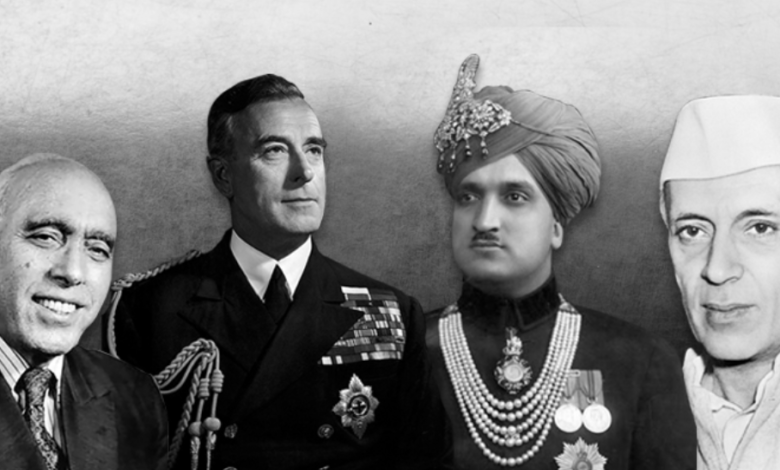
Jammu and Kashmir is observing Accession Day on Monday, marking the signing of the Instrument of Accession by Maharaja Hari Singh in 1947, a defining moment in the region’s modern history that continues to raise questions about the respective roles of the Dogra ruler and National Conference founder Sheikh Mohammad Abdullah.
The formal decision to accede to India was made by Hari Singh, the ruler of the princely state, who signed the Instrument of Accession on October 26, 1947. Lord Mountbatten, then Governor-General of India, accepted it on October 27, the day Indian troops were airlifted to Srinagar to help defend the state against tribal fighters who had entered from Pakistan.
The circumstances leading to the decision were shaped by the crisis that followed Partition. Hari Singh had initially sought to preserve Jammu and Kashmir’s independence, but the invasion and the rapid deterioration of the security situation forced his government to seek military assistance from India. In his letter to Mountbatten dated October 26, the Maharaja said immediate assistance was necessary to save the state and enclosed the Instrument of Accession.
Under the Instrument, the Dominion of India assumed authority over specified subjects, principally defence, external affairs and communications, along with related matters. The document was executed by Hari Singh in his capacity as ruler; Sheikh Abdullah did not sign it.
Abdullah’s role, however, was significant in the political developments surrounding accession. As the leader of the National Conference, which had built a substantial mass following in the Kashmir Valley, he was an important political interlocutor for the Indian leadership. His political alignment with the Congress leadership and his opposition to the forces advancing into Kashmir helped shape the political context in which the accession took place.
Hari Singh’s letter to Mountbatten stated that he intended to establish an interim government and ask Abdullah to take responsibility for its administration during the emergency. Mountbatten’s reply of October 27 acknowledged the Maharaja’s decision to invite Abdullah to form an interim government alongside the existing prime minister. Abdullah subsequently assumed a central role in the administration of Jammu and Kashmir.
The distinction between the two men is important to understanding the accession. Hari Singh possessed the formal authority to execute the Instrument as the state’s ruler, while Abdullah brought political influence and an organized support base at a critical juncture. Neither role should be confused with the other: the Maharaja signed the accession document, while Abdullah became central to the political administration that followed.
The accession also carried an important qualification in Mountbatten’s acceptance letter. The Governor-General stated that, in keeping with the Indian government’s declared policy regarding disputed accessions, the question should be settled in accordance with the wishes of the people once law and order had been restored and the invader cleared from the state. The proposed reference to the people did not take place through a plebiscite, and the question of popular consent has remained central to competing historical and political interpretations of Kashmir’s accession.
Accession Day was added to Jammu and Kashmir’s official list of public holidays in 2019, when the Union Territory’s holiday calendar was revised. Its observance places the events of October 1947 back at the centre of public discussion, including the decisions taken by the Maharaja, the political influence of Abdullah and the circumstances under which the state joined the Dominion of India.
© Kashmir News Trust (KNT). Unauthorized use without attribution is prohibited.