
Cockroach Janta Party: Viral Satire Movement Faces Digital Block After Surpassing BJP Online


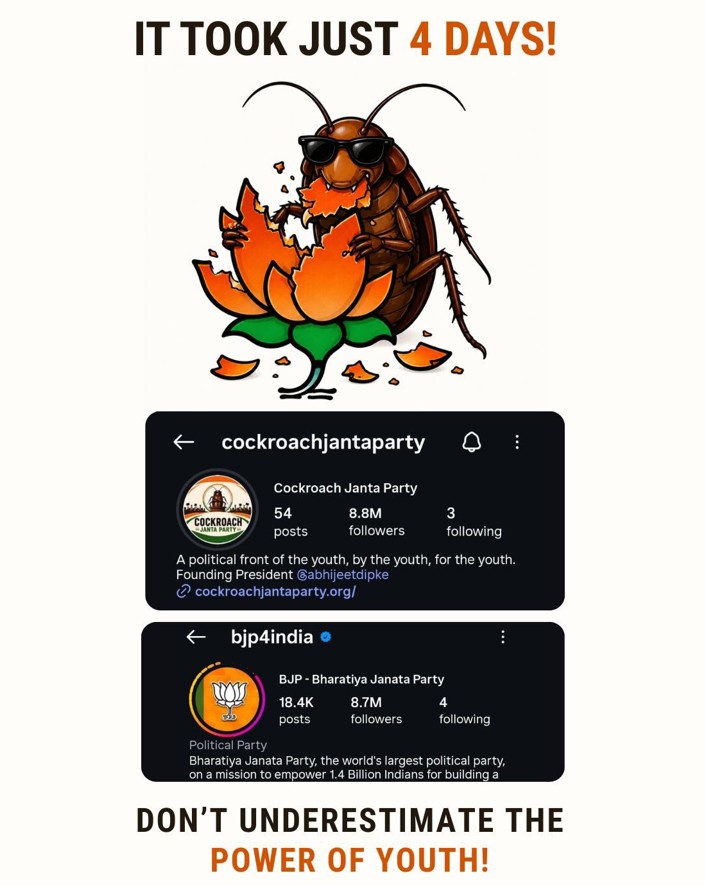
New Delhi, May 21, KNT: The rapidly growing “Cockroach Janta Party” (CJP), a satirical online political movement that exploded across Indian social media within days, entered a fresh controversy on Thursday after its X account was withheld in India shortly after the platform surpassed the Bharatiya Janata Party (BJP) in social media following.
What began as internet satire has now evolved into a wider debate involving free expression, youth frustration and the boundaries of digital dissent.
The controversy erupted after CJP founder Abhijeet Dipke announced that the movement’s X account had been withheld in India. The development came hours after the group’s Instagram following reportedly surged beyond BJP’s online numbers, turning the page into one of India’s most discussed digital phenomena.
The Cockroach Janta Party, despite its unusual name, is not a formally registered political party but a satirical digital campaign that blends humor, protest and political commentary.
The movement traces its origin to public outrage over remarks attributed to Chief Justice Surya Kant during a court hearing, comments that many online users interpreted as equating sections of unemployed youth and activists with “cockroaches.” The remarks triggered widespread criticism before later clarification from the judge.
Against that backdrop, Dipke floated the idea of a “Cockroach Janta Party,” initially as a satirical response.
What followed surprised even its creators.
Within days, the movement amassed massive digital traction, with followers, sign-ups and social media engagement rising at unusual speed. Multiple reports said the campaign crossed millions of followers and attracted participation from students, activists, political observers and disillusioned youth.
Its manifesto and membership rules employed parody and internet humor, describing itself as a platform for the “lazy and unemployed,” while simultaneously touching upon unemployment, political accountability, media criticism and institutional distrust.
Supporters describe the movement as satire carrying genuine political frustration.
Critics, however, have accused the platform of targeting the ruling establishment and promoting anti-government narratives.
Sections of BJP supporters and social media commentators questioned the motives behind the campaign, while some users associated with online political ecosystems alleged ideological bias and described the movement as anti-India.
No official government statement explaining the withholding of the account was immediately available.
That absence of clarity has itself become part of the debate.
The withholding of the account has generated sharp reactions online, with many users questioning whether satirical or dissenting digital movements are increasingly vulnerable to restrictions.
Others argued that online popularity alone does not convert satire into a political force and cautioned against treating follower counts as electoral legitimacy.
The episode nevertheless reveals a changing political landscape where digital platforms, memes and satire increasingly shape public conversation, particularly among younger users frustrated with unemployment, economic pressure and conventional politics.
Whether the Cockroach Janta Party remains a fleeting internet sensation or develops into a larger civic conversation may depend less on its follower count and more on how India negotiates the uneasy space between satire, dissent and digital regulation.
Who Is Abhijeet Dipke and What Is the Cockroach Janta Party Manifesto?
Abhijeet Dipke is the founder and public face of the viral online movement called the Cockroach Janta Party (CJP), a satirical digital platform that rapidly gained attention across Indian social media in May 2026.
Dipke, known primarily through his online activism and social media presence, launched the initiative after controversy erupted over remarks attributed to a senior judge that many internet users interpreted as insulting unemployed youth and activists. The term “cockroach” was subsequently reclaimed by supporters as a symbol of resistance, sarcasm and political protest.
Though not a registered political party, CJP presents itself as a digital protest movement mixing satire, humor and criticism of contemporary politics.
What Does the Cockroach Janta Party Manifesto Say?
The CJP manifesto is deliberately satirical but touches upon real public frustrations.
Some of its notable themes include:
• Voice for the “Ignored”
The movement describes itself as representing unemployed youth, students and those feeling alienated from mainstream politics.
• Criticism of Political and Institutional Power
Posts and manifesto points frequently question political privilege, inequality, media narratives and concentration of power.
• Internet Satire as Protest
CJP uses memes, parody language and exaggerated symbolism rather than conventional political messaging.
• Anti-Establishment Tone
The campaign positions itself as challenging traditional political structures and elite decision-making.
• Digital Democracy and Expression
Supporters argue the movement represents freedom of expression and online dissent, particularly after social media restrictions and account-withholding controversy.
Political Party or Protest Symbol?
Despite millions of followers and massive online traction, Cockroach Janta Party is not officially registered with the Election Commission of India and currently functions more as a viral protest identity and internet-led civic expression than a conventional political organization.
Its sudden rise reflects how political dissatisfaction, satire and social media culture are increasingly intersecting in India’s digital public sphere.
© Kashmir News Trust (KNT). Unauthorized use without attribution is prohibited.