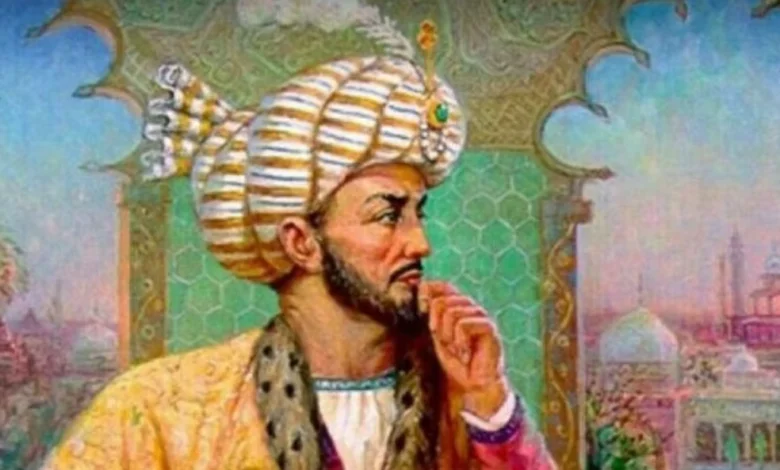
Mughal Emperor Zahiruddin Babar wrote his memoirs, and this delightful book gives intimate glimpses of the man. In it, he tells us about Hindustan and describes its animals, flowers, trees, fruits, and even its frogs. He notes every detail with the eye of a careful observer. At the same time, he sighs for the melons, grapes, and flowers of his native country in Central Asia. His homesickness is clear throughout his writing. Yet alongside this longing, he expresses extreme disappointment at the people of Hindustan. According to him, they did not have a single good point in their favour.
Perhaps Babar did not get to know the people properly during his four years of continuous warfare. The more cultured classes may have kept away from the new conqueror. It is also possible that a newcomer cannot easily enter into the life and culture of another people. Whatever the reason, Babar found nothing admirable, either in the Afghans who had ruled before him or in the majority of the population. He was a keen observer, and even allowing for the bias of a foreign newcomer, his account suggests that North India was in a poor condition at that time. He did not visit South India at all.
“The Empire of Hindustan,” Babar wrote, “is extensive, populous, and rich. On the east, the south, and even the west, it is bounded by the great ocean. On the north it has Kabul, Ghazni, and Kandahar. The capital of all Hindustan is Delhi.” It is interesting that Babar regarded the whole of India as one unit, although when he arrived it was divided into many kingdoms.
He continued his description by emphasizing how different Hindustan was from his homeland. “It is a remarkably fine country. It is quite a different world compared with our countries. Its hills and rivers, its forests and plains, its animals and plants, its inhabitants and their language, its winds and rains, are all of a different nature. You have no sooner passed Sindh than the country, the trees, the stones, the wandering tribes, the manners and customs of the people, are all entirely those of Hindustan. Even the reptiles are different. The frogs of Hindustan are worthy of notice. Though of the same species as our own, yet they will run six or seven gaz on the face of the water.”
Babar then provided lists of the animals, flowers, trees, and fruits found in Hindustan. After describing nature, he turned his attention to the people.
“The country of Hindustan has few pleasures to recommend it,” he declared. “The people are not handsome. They have no idea of the charms of friendly society, or of frankly mixing together or of familiar intercourse. They have no genius, no comprehension of mind, no politeness of manner, no kindness or fellow feeling, no ingenuity or mechanical invention in planning or executing their handicraft works, no skill or knowledge in design or architecture; they have no good horses, no good flesh, no grapes or musk-melons, no good fruits, no ice or cold water, no good food, or bread in their bazaars, no baths or colleges, no candles, no torches, not a candlestick.”
Reading this, one is almost tempted to ask what Hindustan had at all. Babar must have been thoroughly fed up when he wrote these lines.
Yet he did acknowledge certain strengths. “The chief excellence of Hindustan,” Babar wrote, “is that it is a large country and has abundance of gold and silver. Another convenience of Hindustan is that the workmen of every profession and trade are innumerable and without end. For any work and any employment, there is always a set ready, to whom the same employment and trade have descended from father to son for ages.”
Thus, while Babar criticised the people severely, he admitted that the country was vast, wealthy, and full of skilled craftsmen whose trades had been carried on for generations.
Babar died in 1530 at the age of forty-nine. His soldiers carried his body to Kabul, where he was buried in a garden he loved deeply. In death, he returned to the flowers and homeland for which he had always longed.
[Zahir-ud-din Muhammad Babur (1483–1530) was the founder of the Mughal Empire in India. A descendant of Timur on his father’s side and Genghis Khan on his mother’s side, he captured Delhi after defeating Ibrahim Lodi in the First Battle of Panipat in 1526. Babur was not only a skilled military commander but also a sensitive writer and keen observer of nature. His memoirs, the Baburnama, written in Turkish, are among the earliest and most valuable autobiographical works in Islamic literature. He died in 1530 and was buried in Kabul, Afghanistan, in a garden he loved.]