J&K Assembly Session Ends Amid Heated Exchanges, Media Regulation Debate and Major Governance Disclosures

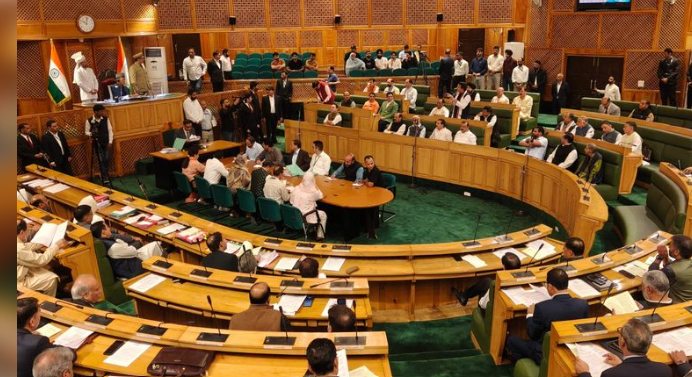
Srinagar, Sep 30: KNT: The Jammu and Kashmir Legislative Assembly’s seven-day Autumn Session concluded on Wednesday amid heated exchanges over the regulation of social media, questions over the role of bureaucracy in legislative affairs and a series of disclosures on employment, electricity, public finances, ration distribution and governance.
The concluding sitting witnessed noisy scenes after Doda MLA Mehraj Malik objected to the discussion on regulating social media, questioning the need for such a debate in the absence of a specific legal framework. Malik entered the Well of the House while pressing his objection, following which Speaker Abdul Rahim Rather directed that he be marshalled out. The episode occurred during a broader debate on the functioning of the media and social media platforms.
The government, meanwhile, announced that a new Media Policy would be framed to address issues relating to social media and digital news platforms. Education and Health Minister Sakina Itoo said a committee had already been constituted in coordination with the Information Department and had sought four months to complete the exercise. She said the proposed framework would provide fresh guidelines for journalists and the media sector, while also acknowledging that politicians themselves shared responsibility for the manner in which social media is used.
The media debate also exposed differing views within the House over the balance between regulation and freedom of expression. While several members sought a legal framework to deal with unregulated and misleading digital content, PDP MLA Waheed-ur-Rehman Para cautioned against measures that could restrict legitimate journalism. CPI(M) MLA M.Y. Tarigami also called for action against deliberately misleading content under existing laws while opposing measures that could curb legitimate media activity.
The controversy over the role of the administration in legislative affairs also remained a significant issue. Members questioned the communications sent by the Chief Secretary and Law Secretary to the Assembly Secretariat concerning the statehood resolution. Peoples Conference MLA Sajad Gani Lone questioned the use of administrative authority in matters concerning elected representatives, while Congress MLA Nizam-ud-Din Bhat had earlier sought that the communications be placed on the Assembly record.
The House also took up a range of governance and public-interest matters during the concluding sitting. Government data placed before the Assembly showed that particulars of 1,00,501 casual and other workers had been registered through an Aadhaar-based biometric identification and skill-profiling exercise, while a committee examining their regularisation had not yet recommended a policy or fixed a timeline for a final decision.
Another disclosure concerned the utilisation of district-level funds. According to government figures placed before the House, Jammu and Kashmir had spent Rs 2,984 crore against Rs 10,641.80 crore released against total district-wise allocations of Rs 16,926.95 crore, putting utilisation at around 28 per cent of the released amount.
The Assembly was also informed that more than 2.25 lakh beneficiaries had been added to the Union Territory’s ration rolls since January this year, while 56,664 beneficiaries had been deleted. The government said Aadhaar seeding of ration cards had reached 100 per cent and clarified that verification did not ordinarily result in cancellation of an entire ration card merely because an individual member was found ineligible.
Employment and recruitment-related concerns also figured in the proceedings. Government data showed that JKPSC and JKSSB had received more than 21 lakh applications for recruitment examinations over three financial years, with job aspirants paying more than Rs 113 crore in application fees. During the period, the two recruiting bodies conducted examinations for 15,964 advertised posts.
The House also dealt with electricity-related issues. Government data placed before the Assembly showed that domestic electricity tariffs for metered consumers had increased by 15 to 25 paise per unit under the 2026-27 tariff structure, while the fixed charge on contracted load had risen from Rs 8 to Rs 10 per kW per month. The Power Development Department said around 66 per cent of the consumer base had been covered by smart metering and that 714 feeders had been declared 24×7.
The concluding proceedings also brought the Jal Jeevan Mission under scrutiny, with the House Committee report on the implementation of the mission being taken up and Jal Shakti Minister Javed Rana facing a rebuke from Speaker Rather after suggesting that the matter should be treated as closed. The Speaker intervened while committee chairman and MLA Hasnain Masoodi was briefing the House on the report.
The session also saw legislative business conclude with five Bills having been passed on Tuesday, while two salary-related Bills concerning ministers and legislators were withdrawn following objections from BJP members. The government’s legislative agenda during the session covered municipal governance, taxation, ease of doing business and living, pension-related provisions and decriminalization and rationalization of offences.
The Assembly was subsequently adjourned sine die, formally bringing the Autumn Session to an end. In his concluding remarks, Speaker Abdul Rahim Rather thanked members, Assembly staff and officials involved in conducting the proceedings and acknowledged the difficulties arising from the limited duration of the session. He urged members to raise their concerns constructively and said legislators should bring to his notice cases where issues or assurances raised in the House were not acted upon.
The session, which began on September 21, thus ended after seven sittings marked by legislative business, public-interest disclosures and sharp political exchanges, with statehood, the functioning of the elected legislature, media regulation and governance issues featuring prominently during its final phase. [KNT]
© Kashmir News Trust (KNT). Unauthorized use without attribution is prohibited.