
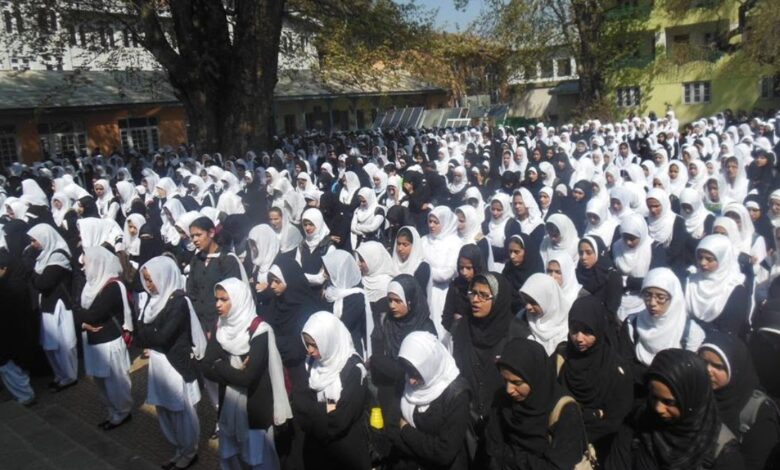
November 14, 1973 opened a new chapter in Kashmir history. The leaders were all set to take the Plebiscite Front to the altar for their vested interests. A deal had been finalized. People, by and large, were scared of indulging in political talk. It was at this crucial juncture of Kashmir’s history that the students of Government College for Women did the “impossible”. Daring cane charge and tear smoke shells, the defiant students made a strong political statement on that day.
The stage was all set for naming the college after the first Prime Minister of India, Jawaharlal Nehru on his birth anniversary. The students resisted the move. Out they came on the ‘posh’ Maulana Azad Road and pelted stones on government vehicles and the police. Unaware of the mood of the girl students, Sheikh Mohammad Abdullah arrived on the scene in his car to preside over the function. He had to retreat as a few stones thrown by “delicate hands” smashed the windscreen. But for this incident, the political wilderness of Plebiscite Front leaders would have ended in 1973 itself. This incident deferred transfer of power to Sher-e-Kashmir by two years, believes noted historian Shabnam Qayoom.
The valiant girls first smashed the signboard that was installed on the main building of the college. The remains of the board remained there till 2009 to remind people of the valiant fight of the college eves. In a jiffy the students of SP College and SP School joined the chorus. Bilquees, a student narrated the story. “As soon as we came out of the college, we saw a young man throwing stones on the police. He guided us and saved many girls from cane wielding policemen. The boy was later identified as Jaleel Andrabi.”
Bilquees and her friends were the last to leave the “battle field”. “We insisted on removal of the board. The authorities promised us immediate action. However, when we looked around, the protesters had left. We were the only persons present on the scene. Then we decided to leave,” she said.
The agitation spread to other districts. People, especially the students, came out in large numbers to protest. They raised slogans against New Delhi and Sheikh Mohammad Abdullah. His effigies were burnt at a number of places. The government was forced to close down all educational institutions indefinitely. When the colleges opened after a fortnight, the students of Regional Engineering College staged a demonstration at Lal Chowk. Brutal police action left several students injured. Scores were taken into custody.
The agitation evoked responses in Jammu as well. The Jammu students attacked MA College and chanted anti-Pakistan slogans.
According to Shabnam Qayoom, the incident took place on November 5, 1973. In his Kashmir ka Siyasi Inqilaab, he says Sheikh Mohammad Abdullah was supposed to preside over the function and faced the wrath of angry students when he was on his way to the college. However, according to Bilquees, it was November 14 and not November 5. “We came to know about the designs of the authorities when all preparations had been finalized. The students were asked to stay back and that is it,” she said. Other students of those times have differed with Shabnam Qayoom.
The college remains nameless to this day. It is still called Government College for Women. Very few persons are aware of the historic role the college played in Kashmir politics at a crucial phase. The daring students gave an opportunity to the resistance forces to regroup.
The much needed regrouping took place and infused new life in the movement, though only for a brief period. After two years the leaders fell from grace. They joined hands with what Sher-e-Kashmir called the “worms of the gutter”. A movement spread over 22 years was brutally killed. Surprisingly, rather shockingly, Kashmiris celebrated the demise.
[Taken from the book ‘Flash Back – Kashmir Story Since 1846 by Zahir-du-Din]© Kashmir News Trust (KNT). Unauthorized use without attribution is prohibited.