Nearly 15,000 Teaching Posts Vacant in J&K Education Department, Raising Questions Over Classroom Strength

Srinagar, Aug 15, KNT: Jammu and Kashmir’s government school system is facing a significant staffing gap, with nearly 15,000 teaching posts, including teachers and masters, reported vacant across the Union Territory, even as NITI Aayog’s latest assessment shows that 1,371 schools are functioning with only one teacher.
The Jammu and Kashmir Government had informed the Legislative Assembly in February that 12,977 teacher posts were vacant across the Union Territory. Of these, 7,985 were in Jammu Division and 4,992 in Kashmir Division.
The vacancy figure rises to 14,923 when the separately reported 1,946 vacant Master posts are included. The Master vacancies comprise 1,722 in Kashmir Division and 224 in Jammu Division.
The district-wise figures show that the shortage is not confined to one part of J&K. In Kashmir Division, Anantnag has the highest number of teacher vacancies at 1,016, followed by Budgam with 797, Pulwama with 764 and Kupwara with 621. Srinagar has 535 vacancies, while Bandipora has 310, Baramulla 284, Shopian 256, Ganderbal 244 and Kulgam 165.
In Jammu Division, Rajouri has the highest number with 1,416 vacant teacher posts, followed by Kathua with 1,332 and Jammu district with 1,234. Poonch has 946 vacancies, Udhampur 912 and Doda 866.
The staffing problem becomes more significant when viewed alongside the latest NITI Aayog report on school education. Based on UDISE+ 2024-25 data, the report as per the news agency Kashmir News Trust records 1,371 single-teacher schools in J&K, with 32,303 students enrolled in them. It also identifies 146 schools with zero enrolment, although 61 teachers were shown as posted in those schools.
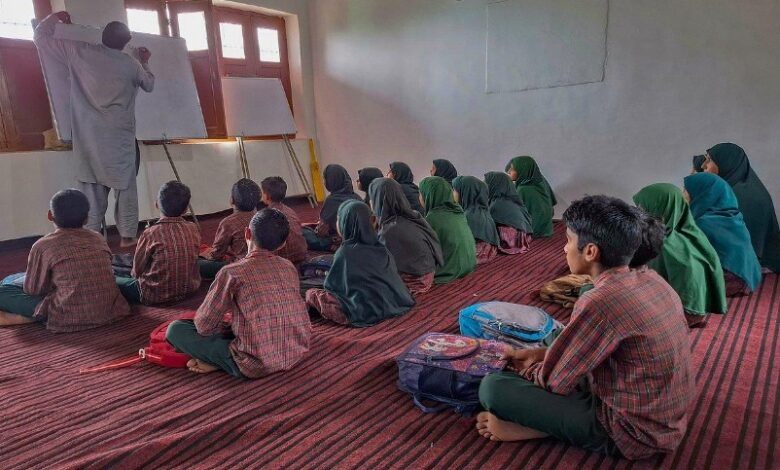
A single-teacher school presents a particular challenge because one teacher may have to handle several grades as well as administrative and other school-related responsibilities. NITI Aayog notes that such arrangements can result in multi-grade classrooms and limit the teacher’s ability to provide grade-specific attention to students.
The numbers also reveal a curious mismatch within the system. On one side, J&K has thousands of reported vacant teaching posts. On the other, hundreds of schools are functioning with only one teacher, while 146 schools have no enrolled students at all.
The Government has indicated that not every reported teacher vacancy represents an immediately recruitable post. It had told the Assembly that available and anticipated vacancies are being utilized for the transition of Teacher Grade-II and Grade-III posts linked to the absorption of regularized Rehbar-e-Taleem teachers.
There are also efforts to fill some of the higher-level vacancies. The Government had said that 1,946 promotional vacancies of Masters are being processed through Divisional Level Departmental Promotion Committees. Separately, 594 Lecturer vacancies have been referred to the Jammu and Kashmir Public Service Commission for recruitment.
In June, the Directorate of School Education Kashmir also identified 5,367 General Line Teacher vacancies and forwarded a proposal to the Administrative Department seeking their de-freezing for recruitment. The proposal does not, however, mean that these posts have already been filled.
The issue is particularly important in remote and geographically difficult areas. In Karnah, for example, the Government told the Assembly in February that 155 teaching posts were vacant, including 55 Lecturer, 35 Master and 65 Teacher posts. The department said the shortage would be managed through staff rationalization and Cluster Resource Coordinators, while clarifying that the teacher vacancies were frozen and therefore not being treated as effective vacancies.
The figures therefore point to a problem more complicated than simply saying that J&K has “13,000 vacant teacher posts”. Some vacancies are frozen, some are tied to cadre restructuring and some are being processed through promotions or recruitment.
But the ground-level question remains: if 32,303 students are studying in 1,371 single-teacher schools, how quickly can the staffing imbalance be corrected?
The issue also acquires significance in light of J&K’s learning outcomes. NITI Aayog’s 2026 report records J&K’s PARAKH 2024 scores at 46 per cent in Language, 39 per cent in Mathematics and 41 per cent in The World Around Us, below the corresponding national averages of 57, 46 and 49 per cent.
Taken together, the data raises questions about whether the present distribution of teachers, schools and students is producing the best possible educational outcomes. The challenge for the School Education Department is not merely to fill vacancies on paper, but to ensure that teachers are available where students actually are, particularly in schools serving remote and difficult-to-reach communities. [KNT]
© Kashmir News Trust (KNT). Unauthorized use without attribution is prohibited.