Autocratic Yet Development-Oriented: Reassessing Dogra-Era Contributions to Kashmir’s Society

The Dogra rulers of Jammu and Kashmir, often viewed through a political lens, also presided over a period marked by structured interventions in environmental protection, education, healthcare, and infrastructure, leaving behind systems that shaped the region’s social and economic fabric.
From the mid-19th century to the mid-20th century, the Dogra dynasty led by Gulab Singh, Ranbir Singh, Pratap Singh and Hari Singh introduced policies and institutions that extended beyond governance into public welfare, resource management, and social development.
The foundation of the princely state under Gulab Singh in 1846 saw the beginning of centralized control over forests and land resources. Early regulations placed restrictions on unauthorized timber extraction, particularly targeting valuable species such as chinar and mulberry. These measures were not only ecological safeguards but also linked to economic activity, especially the silk industry, which relied heavily on mulberry cultivation.
Quick Timeline
- 1846 – Gulab Singh establishes Dogra rule
- 1857 – Ranbir Singh succeeds
- 1885 – Pratap Singh takes over
- 1925 – Hari Singh becomes ruler
- 1947 – Accession to India
- 1952 – End of monarchy
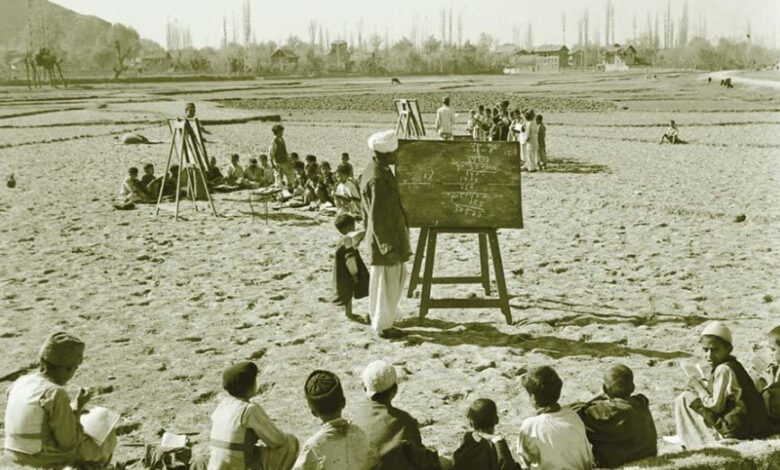
Under Ranbir Singh, administrative structures became more defined. His reign saw the introduction of legal codification, including the Ranbir Penal Code, alongside support for traditional and formal education systems. Schools teaching Persian and Sanskrit were encouraged, gradually incorporating modern subjects as administrative needs evolved.
The subsequent rule of Pratap Singh marked a shift toward institutional expansion. Educational infrastructure widened with the establishment of formal institutions, including colleges in Srinagar, while public works projects improved connectivity. Roads, bridges, and communication systems were developed, linking Kashmir more effectively with surrounding regions. Healthcare also began to take shape during this period, with the establishment of hospitals and dispensaries that introduced organized medical services to the population.
Hari Singh’s rule further accelerated social sector reforms. Compulsory primary education was introduced, expanding access to schooling across sections of society, including girls. Healthcare infrastructure grew with increased focus on vaccination and disease control, while administrative systems became more structured and accessible.
Environmental management remained a consistent feature across the dynasty. Forests were treated as regulated state resources, with restrictions imposed on indiscriminate cutting. The protection of chinar trees, widely regarded as part of Kashmir’s cultural and ecological identity, and mulberry trees tied to economic production, reflected a governance approach that combined conservation with utility.
However, these initiatives were largely state-driven and aligned with administrative priorities, including revenue generation and resource control, rather than purely welfare-oriented motivations. Still, they resulted in the preservation of natural assets and the gradual expansion of public services.
1. Gulab Singh
Reign: 1846 – 1857
- Founder of the princely state of Jammu and Kashmir
- Became Maharaja after the Treaty of Amritsar (purchased Kashmir from the British)
- Unified Jammu, Kashmir Valley, Ladakh, and Baltistan under one rule
2. Ranbir Singh
Reign: 1857 – 1885- Son of Gulab Singh
- Expanded administrative and legal systems (Ranbir Penal Code)
- Strengthened state governance and military
3. Pratap Singh
Reign: 1885 – 1925
- Son of Ranbir Singh
- Initially faced British interference; later restored to full powers
- Saw modernization efforts: roads, telegraph, and infrastructure
4. Hari Singh
Reign: 1925 – 1952 (formally until monarchy abolished)
- Grandson of Ranbir Singh
- Last ruling Maharaja
- Signed the Instrument of Accession in 1947, acceding to India
- Faced internal unrest and the beginning of the Kashmir conflict
📜 After Hari Singh
- 1947: Jammu & Kashmir acceded to India
- 1952: Monarchy formally ended
- His son, Karan Singh, became the constitutional head (Sadr-i-Riyasat, later Governor)
In contrast, present-day Jammu and Kashmir has witnessed rapid urban expansion, infrastructure growth, and population pressures that have significantly altered land use patterns. While development has accelerated in scale and technology, concerns have emerged over the decline in green cover, unregulated construction, and the cutting of heritage trees, including chinar and mulberry, often highlighted in local discourse.
The shift reflects a transition from controlled, state-managed resource use to a more complex system involving multiple stakeholders, where enforcement challenges and competing priorities have impacted environmental safeguards.
The comparison between the two periods underscores a key contrast: while the Dogra era operated within a centralized framework that enforced strict controls over natural resources, the contemporary period faces the challenge of balancing development with conservation in a rapidly changing socio-economic landscape.
As Jammu and Kashmir continues to evolve, the legacy of structured environmental protection and early public welfare systems under Dogra rule remains a point of reference in discussions on sustainable development and governance in the region. [KNT]
© Kashmir News Trust (KNT). Unauthorized use without attribution is prohibited.