Kashmir Gets First 25,000-Litre Community Biogas Plant in Central Kashmir’s Ganderbal

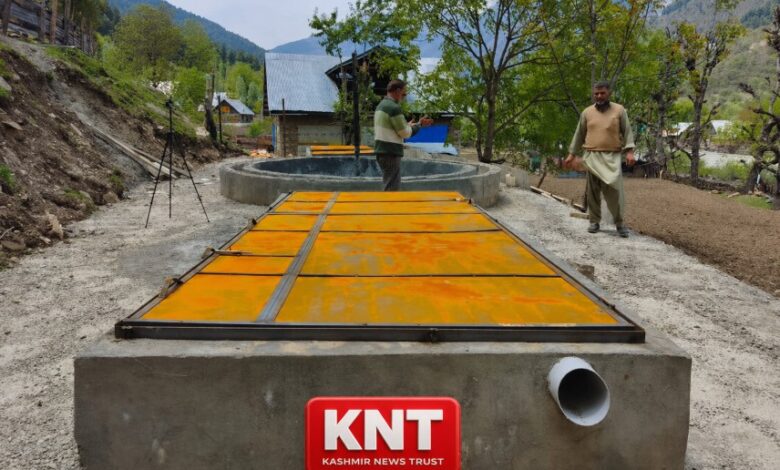
Ganderbal, April 27, KNT: The Rural Development Department (RDD) Kashmir has initiated the construction of a 25,000-litre capacity community biogas plant under the Swachh Bharat Mission – Gramin (SBM-G) in Pathribal Gund area of Ganderbal district, officials said.
The project, with an estimated cost of ₹35 lakh, is part of a Union Territory-wide initiative that envisages the installation of one such plant in each district of Jammu and Kashmir.
Officials said the plant under execution in Ganderbal is expected to be the first of its kind to become operational in the Kashmir Valley, marking a step toward decentralized renewable energy generation and structured rural waste management.
The facility will operate on anaerobic digestion, using cattle dung sourced from the local community on a rotational basis. Through microbial decomposition in an oxygen-free environment, the process will generate methane-rich biogas and organic slurry.
The biogas produced is intended to meet cooking fuel needs of around 10 households, while the slurry will be used as nutrient-rich manure for agricultural purposes.
To address climatic challenges in the region, the digester is being equipped with a thermostatic control system to maintain optimal temperatures for microbial activity. In addition, IoT-based sensors are being integrated to monitor parameters such as gas pressure, temperature, pH levels, and feedstock input in real time.
Officials told the news agency Kashmir News Trust that the project is designed to reduce dependence on conventional fuels such as LPG and firewood, while also providing a structured mechanism for disposal of cattle waste.
The initiative is also expected to contribute to environmental goals by reducing methane emissions from unmanaged waste and supporting sustainable agricultural practices.
A community participation model has been planned for the plant’s operation, with local households and dairy farmers contributing feedstock. A user-group committee will be formed to oversee operations, maintenance, and equitable distribution of biogas.
Authorities said the project will serve as a demonstration model for similar installations across the Union Territory, highlighting the feasibility of community-scale biogas systems in high-altitude regions. [KNT]
© Kashmir News Trust (KNT). Unauthorized use without attribution is prohibited.
![PCC Asks DC Pulwama to Shut Down Illegal Brick Kilns, 18 Brick Kilns Face Regulatory Violations, 7 Listed Without Consent Pulwama, Aug 8, KNT: Pollution Control Committee has asked Deputy Commissioner to shut down illegal brick kilns in South Kashmir's Pulwama district. The latest status of brick kilns operating in south Kashmir's Pulwama district has revealed serious regulatory concerns, with 18 units listed either without consent, with expired Consent to Operate (CTO), or under a “Refused” status. The status details show that seven brick kilns are listed as operating “Without consent”, indicating that the units do not have the required regulatory consent to operate. The seven units are Dar Brick Kiln (415) at Alliepora Shahoora, LBK changed into Bhat Brick Kiln (151) at Nownagri Pulwama, Kamran Brick Kiln 777 at Parigam Newa, Budshah Brick Kiln at Audoora Pulwama, JKB Sanzan (151) at Astapora Sanzan, 417 Brick Kiln changed into 7HH at Achan Litter Pulwama, and Five Star Brick Kiln at Wahipora Pulwama. The list further shows eight brick kilns with expired CTOs, meaning their consent to operate has lapsed. These include Hilal Brick Kiln, Allie Brick Kiln, Bashir Ahmad Magray, Sunflower Brick Kiln, Jalal Brick Kiln, Magray Brick Kiln, Thoker Brick Kiln (A-No) and Shahoorа Brick Kiln (ATM). Another three units have been marked “Refused” in the consent status. These are Mir Brick Kiln at Hastikhud Zadoora Newa, Gulmour Brick Kiln at Tumchinowpora and Dar Brick Kiln at Tumchinowpora. The status as per the news agency Kashmir News Trust also contains brick kilns holding valid CTOs, indicating that the regulatory violations are not uniform across the district. The findings assume significance in view of the Jammu & Kashmir Pollution Control Committee's direction to the Deputy Commissioner, Pulwama, to initiate action against brick kilns operating without the requisite permissions and in violation of environmental regulations. The presence of multiple units with expired or refused consent, besides those listed without consent altogether, raises serious questions over their continued operation and the effectiveness of regulatory enforcement in the district. The concerned authorities are now expected to verify the operational status of these units and take action against those found functioning without valid statutory consent. [KNT]](https://newsagencyknt.com/wp-content/uploads/2026/06/Brick-Kiln-390x220.jpg)