From Social Media Satire to Jantar Mantar: How the Cockroach Janta Party Took India’s Youth Anger to the Streets

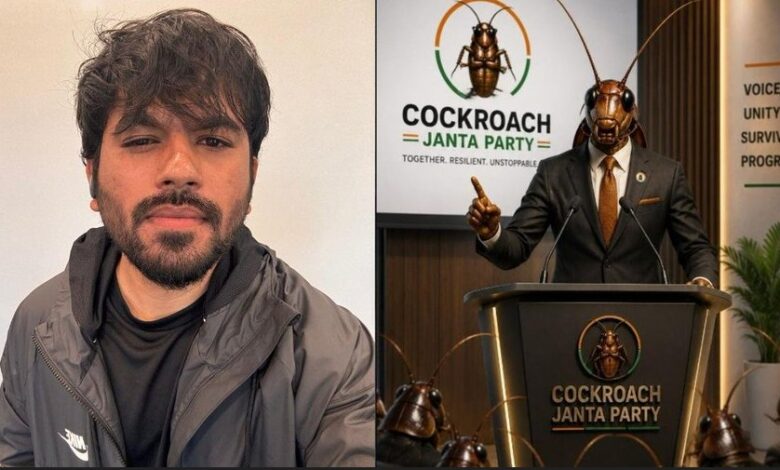
New Delhi, June 6, KNT: What began as a satirical social media campaign has now transformed into one of the most talked-about youth-led protest movements in India.
Hundreds of young people gathered at Jantar Mantar in New Delhi on Saturday as Abhijeet Dipke, founder of the rapidly growing Cockroach Janta Party (CJP), arrived in the national capital to lead the organization’s first major street protest against the Narendra Modi government. According to Reuters, the movement has amassed nearly 22 million followers on Instagram within weeks, making it one of the largest online youth mobilizations in the country.
The protest centered around allegations of examination irregularities, paper leaks, recruitment concerns and growing frustration among students and job-seekers. Demonstrators demanded the resignation of Union Education Minister Dharmendra Pradhan and called for reforms in the education and recruitment systems.
The origins of the movement are unusual.
According to the Associated Press, the Cockroach Janta Party emerged after comments comparing unemployed youth to cockroaches triggered widespread discussion online. Dipke and his supporters embraced the label and converted it into a symbol of resistance, frustration and youth identity.
What initially appeared to be political satire quickly evolved into a broader platform for expressing anger over unemployment, inflation, examination controversies and limited opportunities for young Indians. Reuters reported that youth unemployment and repeated exam-related controversies became major rallying points for the movement.
Saturday’s protest represented the first attempt to convert online popularity into a physical movement.
Dipke, who had been residing in the United States, returned to India specifically for the demonstration. Before arriving, he publicly acknowledged fears that he could face detention or legal action but said he was prepared to continue the campaign. Reuters quoted him as saying he was willing to sacrifice his freedom for the cause.
His arrival in Delhi was accompanied by heightened security arrangements.
Media reports indicated that thousands of police personnel were deployed across central Delhi and around Jantar Mantar amid concerns over law and order. Authorities barricaded several roads leading to the protest venue.
The movement repeatedly emphasized that the protest should remain peaceful.
Organizers urged participants to carry the national flag, bring books symbolizing education, cooperate with police and avoid provocation. Protest instructions circulated by the organization advised supporters to remain disciplined, hydrated and non-violent.
The government’s response has been cautious but critical.
Reuters reported that the movement’s account on X was blocked in India, leading to a legal challenge by the organization. Union Minister Kiren Rijiju accused the group of seeking support from hostile and anti-India elements, allegations rejected by supporters of the movement.
The ruling BJP has sought to downplay the political significance of the campaign, describing it as largely a social media phenomenon. However, political observers quoted by international media note that the rapid rise of the movement reflects genuine concerns among young Indians over jobs, education and economic opportunities.
The movement has also attracted support beyond its original online base.
Environmental activist Sonam Wangchuk publicly expressed support for the protest, while some regional political groups and student organizations endorsed the demonstration. Reports from several states suggested that students and youth activists travelled to Delhi to participate in the event.
At Jantar Mantar, the symbolism was impossible to miss.
Many protesters carried books, waved the national flag and raised slogans demanding accountability for examination controversies. According to media reports, some participants wore cockroach-themed masks and banners, transforming an internet meme into a political symbol.
Whether the Cockroach Janta Party can sustain momentum beyond social media remains an open question.
Political analysts note that India has witnessed several viral movements that generated enormous online attention but struggled to create durable political structures. Yet supporters argue that the movement’s rapid growth demonstrates the depth of frustration among a generation facing educational uncertainty, competitive examinations, recruitment delays and unemployment concerns.
For now, the significance of Saturday’s protest lies less in the size of the crowd and more in what it represents: the emergence of a digitally driven youth movement attempting to convert online influence into real-world political pressure.
Whether it becomes a lasting force in Indian politics or remains a powerful moment of protest will likely depend on its ability to move beyond slogans and social media and channel the grievances of millions of young Indians into a sustained campaign for change. [KNT]
© Kashmir News Trust (KNT). Unauthorized use without attribution is prohibited.