
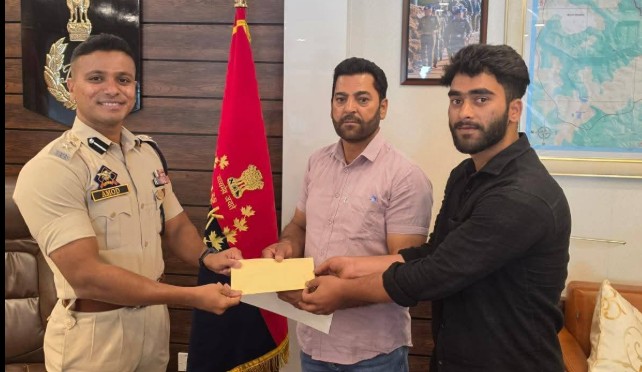
Anantnag, June 15, KNT: Senior Superintendent of Police (SSP) Anantnag, Ashok Amod Nagpure, on Monday felicitated Constable Fayaz Ahmad for his role in tracing three missing minor girls whose disappearance had triggered widespread concern in the district.
The recognition comes days after the three girls, who had gone missing from the Nunwani area of Brakpora, were successfully traced and reunited with their families, ending nearly 24 hours of anxiety and uncertainty.
Police said Constable Fayaz Ahmad played a significant role in the operation that ultimately led to the safe tracing of the girls from Cafeteria Park in Achabal.
The disappearance of the minors had prompted an intensive search operation involving police teams and local volunteers, with concern mounting as the girls remained untraceable for several hours.
The successful recovery brought relief to the families and local residents, while also drawing appreciation for the efforts of the police personnel involved in the search.
During the felicitation, SSP Nagpure commended the dedication, alertness and professionalism displayed by the constable and emphasized the importance of prompt action in cases involving missing children.
Police officials said the recognition was aimed at encouraging personnel who demonstrate exceptional commitment while discharging their duties and serving the public.
The recovery of the girls was widely welcomed in the district, where residents had closely followed the search efforts before the children were found safe. [KNT]
© Kashmir News Trust (KNT). Unauthorized use without attribution is prohibited.