

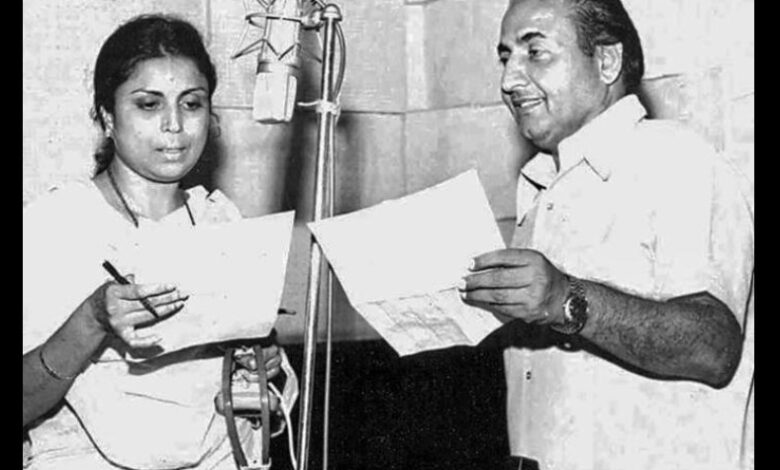
Veteran playback singer Suman Kalyanpur, whose melodious voice defined an era of Indian cinema music and enchanted generations of listeners, passed away in Mumbai on Sunday due to age-related ailments. She was 89.
Her passing marks the end of another celebrated chapter in India’s musical legacy, with tributes pouring in for a singer remembered for her graceful vocals, versatility and enduring contribution to film and non-film music.
According to reports, Kalyanpur passed away peacefully at her residence in Lokhandwala, Mumbai. Close associates said she had been facing age-related health issues.
Born as Suman Hemmadi in 1937, she emerged as one of India’s most respected playback singers and built a distinguished career spanning several decades. She recorded songs in multiple languages, including Hindi, Marathi, Bengali, Assamese, Kannada and Odia, besides devotional and semi-classical compositions.
Kalyanpur earned widespread acclaim during the 1960s and 1970s and carved out a unique musical identity with songs such as “Aaj Kal Tere Mere Pyar Ke Charche,” “Na Na Karte Pyar Tumhin Se” and “Tumne Pukara Aur Hum Chale Aaye.”
Music lovers often associated her voice with the golden age of Hindi cinema, and although comparisons were frequently drawn with legendary singer Lata Mangeshkar owing to vocal resemblance, Kalyanpur maintained her own distinct place in Indian playback history.
A recipient of several honors during her lifetime, including the Padma Bhushan, Kalyanpur’s contribution to Indian music continued to be celebrated long after her active years in playback singing.
Her death prompted grief across the music fraternity and among admirers who remembered her timeless songs and gentle musical expression.
Suman Kalyanpur’s Most Memorable Songs and Musical Journey
Suman Kalyanpur belonged to the golden generation of Indian playback singing, building a career that stretched across more than six decades. Born as Suman Hemmadi in 1937, she entered music through radio and Marathi cinema before moving into Hindi films during the 1950s. Her early break came after singer Talat Mahmood reportedly heard her perform and encouraged her entry into playback singing.
What made Kalyanpur distinctive was her soft, delicate and highly controlled voice. Many listeners compared her voice to that of Lata Mangeshkar, a comparison that followed her throughout her career, though she eventually carved out an unmistakable identity of her own.
Her career gained momentum during the 1950s–1970s, when she worked with major composers including Naushad, S.D. Burman, Madan Mohan, Roshan, Khayyam, Ravi, Shankar-Jaikishan and Laxmikant-Pyarelal. She recorded over 740 film and non-film songs and sang in several Indian languages besides Hindi.
Some of Her Most Memorable Songs
“Aaj Kal Tere Mere Pyar Ke Charche”
Film: Brahmachari (with Mohammed Rafi)
Perhaps her most widely recognized song, this lively duet became one of Hindi cinema’s enduring romantic hits.
“Na Na Karte Pyar Tumhin Se”
Film: Jab Jab Phool Khile
A playful and melodious duet remembered across generations.
“Tumne Pukara Aur Hum Chale Aaye”
Film: Rajkumar (with Mohammed Rafi)
One of her most emotionally resonant romantic songs and a favorite among classic music lovers.
“Parbaton Ke Pedon Par Shaam Ka Basera Tha”
Film: Shagoon
Set to Khayyam’s music, the song is regarded as one of the finest poetic duets of its era.
“Na Tum Hamen Jano”
Film: Baat Ek Raat Ki
A haunting melody sung with Hemant Kumar that remains among Hindi cinema’s most admired romantic compositions.
“Mera Pyar Bhi Tu Hai”
Film: Saathi (with Mukesh)
A lyrical and emotionally layered duet showcasing her vocal elegance.
“Bujha Diye Hain Khud Apne Haathon”
Film: Shagoon
A powerful solo displaying her depth and command over melancholy expression.
Her Partnership With Mohammed Rafi
One of the defining features of Suman Kalyanpur’s career was her collaboration with Mohammed Rafi. During a period when Lata Mangeshkar and Rafi had differences over royalty issues, Kalyanpur recorded extensively with him and went on to sing more than 140 duets with the legendary singer.
A Legacy Beyond Comparison
Despite persistent comparisons with Lata Mangeshkar, admirers and fellow musicians remember Suman Kalyanpur for her own musical identity—graceful, understated and emotionally rich. Singer Kavita Krishnamurti recently described her as “the last great singer of that era.”
Her songs continue to live on not merely as nostalgia, but as part of India’s musical heritage.
© Kashmir News Trust (KNT). Unauthorized use without attribution is prohibited.