Jammu Notices Leave Hundreds of Rohingya Families Facing Eviction, Lost Livelihoods

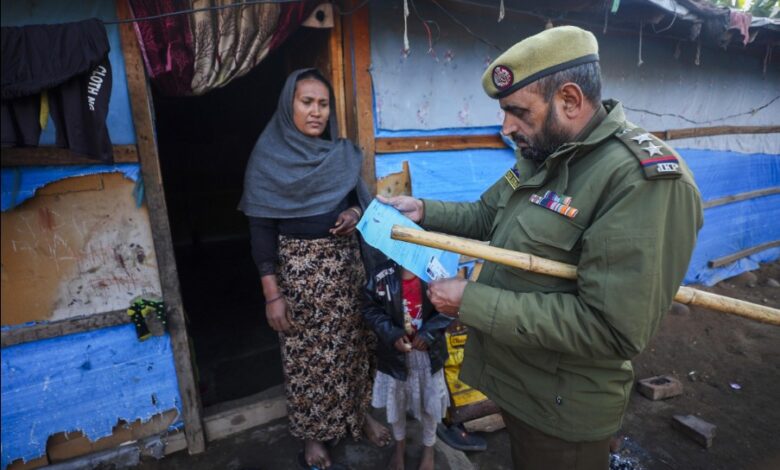
Jammu, Sep 17, KNT: A fresh administrative action against Rohingya settlements in Jammu has left dozens of families dismantling makeshift homes and shops after notices were served on landowners whose plots were being used for residential and commercial purposes in the Kiryani Talab-Burma Market area of Narwal.
The action has placed the immediate burden of the land-use enforcement drive on families who say they have lived in the settlement for years and depend largely on daily-wage work and small shops for survival. Rohingyas have said they were asked to vacate within three days, while accounts from the settlement indicate that around 30 to 40 shops were initially removed before residents began dismantling residential structures. One resident said families did not know where they would go after leaving.
The administration’s reported action is focused on landowners. Notices have been issued on the ground that agricultural land was allegedly being sub-let for residential use, with owners asked to remove the structures from their plots. The notices have consequently set off a process in which families are themselves pulling down huts, packing household belongings and vacating the area.
The scale of the displacement is significant. Residents have claimed that more than 500 families living in roughly 80 to 90 makeshift huts have been asked to leave, although the exact number affected has not been independently established. The settlement in the Burma Market area has reportedly existed for more than two decades.
The latest action comes amid a sharp increase in official scrutiny of Rohingya settlements in Jammu and Kashmir. Government data presented before the Centre’s High-Level Committee on Demographic Change in August showed 7,656 Rohingyas identified across J&K, including 6,737 in the Jammu division and 919 in the Kashmir Valley.
The committee as per the news agency Kashmir News Trust visited Jammu in August and inspected a Rohingya settlement in the Narwal area. The present notices followed that visit, although no official material reviewed for this report establishes that the latest land action was ordered specifically on the recommendation of the committee.
For the affected families, the problems extend beyond the immediate loss of shelter. Many rely on informal employment, daily wages and small-scale commercial activity. Leaving the settlement therefore threatens both housing and income at the same time. Residents have also said they have no clear information about where they are expected to relocate.
Documentation is another major issue. UNHCR states that registration and documentation are important for refugees and asylum-seekers because they facilitate access to assistance and protection and help establish identity and individual circumstances. UNHCR’s current India programme lists access to education, health facilities, livelihood assistance, documentation and protection among the services supported through its partners, including ActionAid in Jammu.
The absence of a clear alternative shelter arrangement creates an additional vulnerability for families being asked to leave. The material reviewed for this report does not show any publicly announced rehabilitation or alternative accommodation plan linked to the present notices. This leaves families facing the possibility of moving from makeshift housing to an uncertain living arrangement while also losing the locations from which they earn their livelihoods.
Jammu has also previously featured in international concerns over the detention of Rohingya refugees. A United Nations human-rights communication has recorded allegations concerning prolonged detention, inadequate conditions and lack of appropriate medical care involving Rohingya detainees, including people held at the Hirangar holding centre in Kathua.
An official said that the administration has the authority to enforce land-use and tenancy rules where violations are established, but the immediate humanitarian consequences for families who lose both shelter and livelihood remain. The publicly available material reviewed so far does not clarify what arrangements, if any, have been made for vulnerable families, children, elderly residents or people holding UNHCR documentation.
The notices may resolve the administration’s immediate concern over the use of the plots, but for the families dismantling their homes, the larger uncertainty is what happens after the structures come down. [KNT]
© Kashmir News Trust (KNT). Unauthorized use without attribution is prohibited.