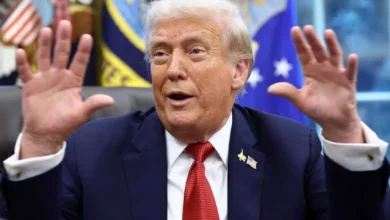

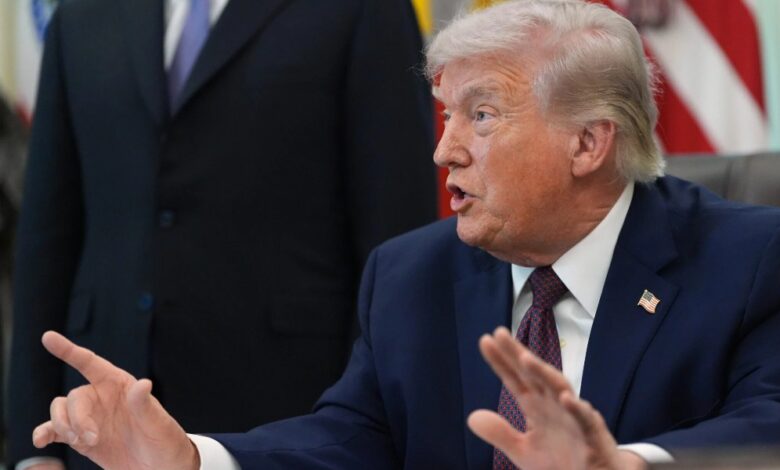
United States President Donald Trump triggered global attention on Monday after claiming that he had paused a planned military strike on Iran following intervention by key Gulf leaders, including Saudi Crown Prince Mohammed bin Salman and Qatar Emir Sheikh Tamim bin Hamad Al Thani.
In a post on his Truth Social platform, Trump said Gulf leaders personally appealed to him to halt the proposed military action against Iran in order to allow diplomatic negotiations to continue.
“I have been asked by the Emir of Qatar, Tamim bin Hamad Al Thani, the Crown Prince of Saudi Arabia, Mohammed bin Salman Al Saud, and the President of the United Arab Emirates, Mohamed bin Zayed Al Nahyan, to hold off on our planned Military attack of the Islamic Republic of Iran,” Trump wrote.
The president claimed the strike had been scheduled for the following day but was paused after Gulf leaders conveyed that serious diplomatic efforts were underway and that an agreement with Tehran could still be reached.
Trump said the Gulf leaders assured him that negotiations could succeed if given additional time, while emphasizing that any agreement must guarantee that Iran would not acquire nuclear weapons.
The statement immediately generated international attention because it appeared to publicly reveal the existence of a planned American military operation against Iran, while simultaneously exposing behind-the-scenes diplomatic intervention by influential Middle Eastern states.
Trump, however, maintained a hardline posture toward Tehran and warned that the United States remained prepared for military action if negotiations failed.
“We remain fully prepared for a full, large scale assault of Iran, on a moment’s notice,” Trump wrote in the post.
The remarks came amid growing regional tensions linked to Iran’s nuclear program, military activities, and wider instability across the Middle East.
The disclosure also highlighted the increasingly active diplomatic role being played by Gulf powers such as Saudi Arabia, Qatar, and the United Arab Emirates in efforts aimed at preventing a wider regional conflict.
Political observers said Trump’s comments reflected a dual strategy of pressure and deterrence, combining threats of military action with signals that diplomatic engagement remained possible.
The statement further underscored the delicate geopolitical balancing underway in the Gulf, where countries have attempted in recent years to reduce direct confrontation with Iran while maintaining close strategic relations with Washington.
The involvement of Gulf leaders in urging restraint was viewed by analysts as significant because any military confrontation involving Iran could directly affect the wider Gulf region, including energy infrastructure, maritime trade routes, and regional security arrangements.
Trump’s remarks also revived debate over his approach toward Iran during his presidency, which was marked by the withdrawal of the United States from the 2015 nuclear agreement and the implementation of severe economic sanctions on Tehran.
Iran has repeatedly insisted that its nuclear program is intended for peaceful purposes, while Western powers and Israel have accused Tehran of pursuing capabilities that could eventually lead to nuclear weapons development.
Although no immediate official response was issued by Iranian authorities regarding Trump’s latest statement, regional media and international analysts closely monitored the development amid concerns about escalating rhetoric.
The disclosure additionally sparked political discussion in the United States, where Trump remains a dominant figure ahead of the presidential election cycle and continues to use Truth Social as a platform for major political and foreign policy announcements.
Security analysts said the public acknowledgment of an alleged planned strike could further complicate already fragile diplomatic channels involving Iran and Western powers.
At the same time, Trump’s comments were seen as an attempt to project both military strength and diplomatic leverage by portraying Gulf leaders as actively seeking his intervention and cooperation.
The latest development added another layer of uncertainty to an already volatile Middle East environment shaped by nuclear tensions, proxy conflicts, maritime security concerns, and shifting regional alliances.
International observers said the coming days could prove crucial in determining whether diplomacy gains momentum or whether regional tensions escalate further.
Further reactions from Gulf governments, Washington, and Tehran were awaited.
© Kashmir News Trust (KNT). Unauthorized use without attribution is prohibited.