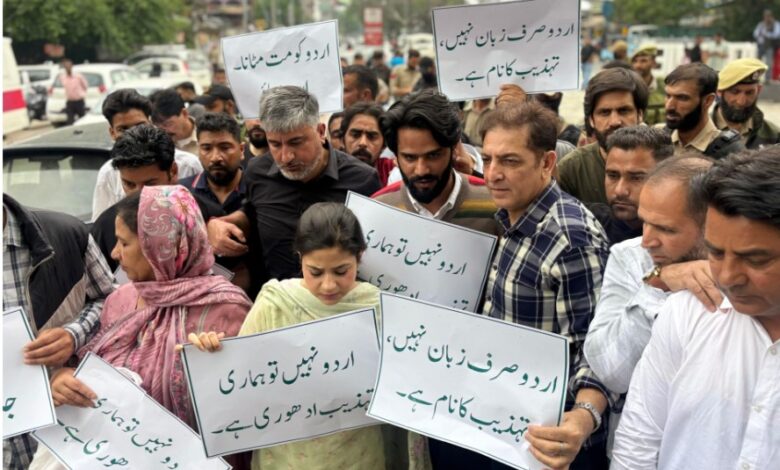
There is no formal order removing Urdu from Jammu and Kashmir’s official framework. On paper, the language retains its place. In practice, however, Urdu appears to be steadily losing ground—quietly edged out by the growing use of Hindi terminology in official communication.
A visible sign of this shift is emerging in government press releases issued by the Department of Information and Public Relations. Increasingly, these communications are marked by a heavy infusion of Hindi words, phrases, and slogans. Welfare schemes, public campaigns, and administrative drives are often framed in a vocabulary that departs from the region’s long-standing Urdu-based official style.
This is not merely a linguistic preference; it is an institutional signal. Language in government communication shapes accessibility, identity, and continuity. For decades, Urdu functioned as the connective administrative language—understood across regions and communities. Its gradual displacement in everyday official discourse risks weakening that shared link.
The issue, therefore, is not about legality but about practice. Urdu has not been removed, but its operational space is narrowing. When official messaging consistently leans toward another language, it inevitably alters both perception and usage patterns. Over time, what remains intact in law can diminish in relevance on the ground.
What makes this trend more concerning is its subtlety. There has been no explicit policy shift, no public debate outlining a transition. Instead, the change is unfolding through routine communication—press notes, campaign material, and official messaging—where linguistic choices accumulate into a broader transformation.
This is not an argument against multilingualism. Jammu and Kashmir is linguistically diverse, and inclusivity demands space for multiple languages. But inclusivity should not come at the cost of displacement. A balanced approach would ensure that Urdu retains its functional prominence alongside other languages, rather than being gradually sidelined.
If left unaddressed, the current trajectory risks turning Urdu into a symbolic language—present in statutes but absent in practice. The challenge for policymakers is to ensure that administrative convenience does not override linguistic continuity.
Because in governance, what is written is not as important as what is used.