
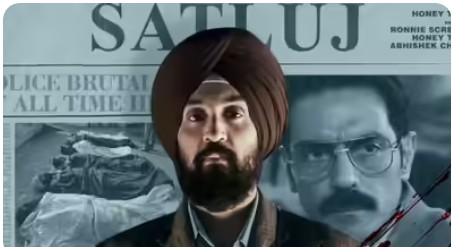
The sudden removal of Satluj, a film starring popular singer-actor Diljit Dosanjh and inspired by the life of human rights activist Jaswant Singh Khalra, from the streaming platform ZEE5 has triggered a fresh controversy, with the makers claiming the decision was taken on government directions.
The film, which premiered on ZEE5 on Friday, was removed from the platform within two days. In a statement, ZEE5 said Satluj would remain unavailable in India “until further notice” due to “current developments” but did not elaborate on the reasons behind the decision.
With the film withdrawn from the platform, it is no longer officially available for viewing in India.
According to The Indian Express, a spokesperson for RSVP Movies, the film’s production house, claimed the removal followed directions from the government. However, the Union Ministry of Information and Broadcasting has not issued any official statement on the matter.
Addressing the controversy during a live interaction on social media, Diljit Dosanjh said he had anticipated the film could face restrictions but was surprised by the speed with which it was taken down.
“I thought the film might get banned when government offices opened on Monday, but I didn’t expect it to happen on Sunday evening,” he said, adding that the uncertainty surrounding the release was the reason the makers kept promotional activities to a minimum.
Despite the setback, Dosanjh expressed satisfaction that audiences were at least able to watch the film after years of delays.
Directed by Honey Trehan, Satluj is inspired by the life of Jaswant Singh Khalra, the human rights activist who investigated allegations of enforced disappearances and illegal cremations during Punjab’s militancy era. Khalra disappeared in 1995 and was later found to have been abducted and murdered. Several Punjab Police personnel were subsequently convicted for their role in the crime.
Set against the backdrop of Punjab’s insurgency from the early 1980s to the mid-1990s, the film explores allegations of human rights abuses, including enforced disappearances and extrajudicial killings during the anti-insurgency operations. While human rights groups documented such allegations, authorities at the time maintained that strong measures were necessary to combat militancy.
The project has faced repeated hurdles since its completion in 2022. Originally titled Ghallughara, a term associated with two major massacres of Sikhs in the eighteenth century, the film was later renamed Punjab ’95 after the Central Board of Film Certification (CBFC) reportedly objected to its original title during the certification process.
According to director Honey Trehan, the CBFC initially proposed 21 cuts, which later expanded to 127 suggested changes, including the removal of references to Khalra, edits to scenes depicting police violence and modifications to factual references. Trehan has maintained that implementing the suggested changes would have fundamentally altered the film. The CBFC has not publicly responded to these claims.
The prolonged dispute also resulted in the film being withdrawn from its scheduled premiere at the 2023 Toronto International Film Festival, while legal proceedings initiated by the filmmakers were later withdrawn in an attempt to secure certification.
Last week, the makers announced that the film would bypass theatrical release and instead premiere directly on ZEE5 under the title Satluj. Since films released exclusively on streaming platforms do not require CBFC certification, the film was released without the cuts earlier sought by the certification board, although the original title Punjab ’95 was not restored.
On the day of its digital release, director Honey Trehan stated that the film had been released “without any cuts or compromises” in the form originally intended by its makers.
Following its removal, Trehan told The Indian Express that he was “at a loss” and unsure how to react to the development.
ZEE5, while confirming the takedown, said it continued to support the film and its “creative vision” and hoped to make it available again, though it did not indicate any timeline for its return.
The controversy has reignited debate over artistic freedom, film certification, digital content regulation and the portrayal of politically sensitive chapters of India’s history.
© Kashmir News Trust (KNT). Unauthorized use without attribution is prohibited.